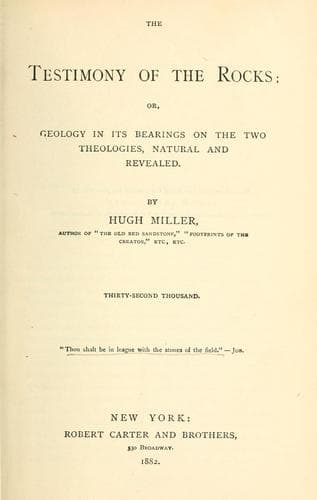
The Testimony of the Rocks: or, Geology in Its Bearings on the Two Theologies, Natural and RevealedMiller, Hugh
Philosophy
The Testimony of the Rocks: or, Geology in Its Bearings on the Two Theologies, Natural and Revealed
Miller, Hugh
Bible and geology; Creation; Religion and science
So far the author of the Treatise. He might have added further, that
from the nature of things, the revelation to Moses in this instance
_must_ have been "sight or vision," if, indeed, what is not in the least
likely, the peculiar architecture and style of ornament used in the
Tabernacle was not a borrowed style, already employed in the service of
idolatry. An old, long established architecture can be adequately
described by speech or writing; a new, original architecture can be
adequately described only by pattern or model, that is, by sight or
vision. Any intelligent cutter in stone or carver in wood could furnish
to order, though the order were merely a verbal one, a Corinthian or
Ionic capital; but no such mechanic, however skilful or ingenious, could
furnish to order, if unprovided with a pattern or drawing, a _facsimile_
of one of the ornately sculptured capitals of Gloucester Cathedral or
York Minster. To ensure a _facsimile_ in any such case, the originals,
or representations of them, would require to be submitted to the
eye,--not merely described to the ear. Nay, from the example given in
the text,--that of the golden candlestick,--we have an instance
furnished in recent times of the utter inadequacy of mere description
for the purposes of the sculptor or artist. Ever since copperplate
engravings and illustrated Bibles became comparatively common,
representations of the branched candlestick taken from the written
description have been common also. The candlestick on the arch of Titus,
though not deemed an exact representation of the original one described
in the Pentateuch, is now regarded,--correctly, it cannot be
doubted,--as at least the nearest approximation to it extant. Public
attention was first drawn to this interesting piece of sculpture in
comparatively modern times; and it was then found that all the previous
representations taken from the written description were widely
erroneous. They only served to show, not the true outlines of the golden
candlestick, but merely that inadequacy of verbal description for
artistic purposes which must have rendered _vision_, or, in other words,
optical representation, imperative in the case of Moses. Some of our
most sober minded commentators take virtually the same view of this
necessity of vision for ensuring the production of the true pattern of
the Tabernacle. "The Lord," says Thomas Scott, "not only directed Moses
by words how to build the Tabernacle and form its sacred furniture, but
showed him a model exactly representing the form of every part, and the
proportion of each to all the rest." There must have been clear optical
vision in the case,--"vision without dark speeches." Such, too, was the
character of other of the Mosaic visions, besides that of the "pattern"
seen in the Mount. The burning bush, for instance, was a vision
addressed to the eye; and seemed to come so palpably under the ordinary
optical laws, that the prophet _drew near_ to examine the extraordinary
Public-domain text, read in full here on John Shaqi.
Reviews
Reviews
No reviews yet
Be the first to share your thoughts on this work.
Elsewhere in the archive
Join the Discussion
Join the discussion
Sign in to leave a comment or review.
Sign InorCreate an account