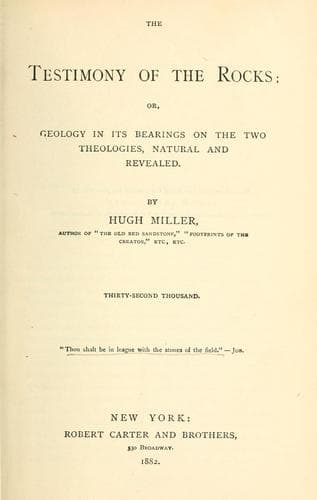
The Testimony of the Rocks: or, Geology in Its Bearings on the Two Theologies, Natural and RevealedMiller, Hugh
Philosophy
The Testimony of the Rocks: or, Geology in Its Bearings on the Two Theologies, Natural and Revealed
Miller, Hugh
Bible and geology; Creation; Religion and science
The science of the geologist seems destined to exert a marked influence
on that of the natural theologian. For not only does it greatly add to
the materials on which the natural theologian founds his deductions, by
adding to the organisms, plant and animal, of the present creation the
extinct organisms of the creations of the past, with all their
extraordinary display of adaptation and design; but it affords him,
besides, materials peculiar to itself, in the history which it furnishes
both of the appearance of these organisms in time, and of the wonderful
order in which they were chronologically arranged. Not only--to borrow
from Paley's illustration--does it enable him to argue on the old
grounds, from the contrivance exhibited in the _watch_ found on the
moor, that the watch could not have lain upon the moor forever; but it
establishes further, on different and more direct evidence, that there
was a time when absolutely the watch was not there; nay, further, so to
speak, that there was a previous time in which no watches existed at
all, but only water clocks; yet, further, that there was a time in which
there were not even water clocks, but only sundials; and further, an
earlier time still in which sundials were not, nor any measurers of time
of any kind. And this is distinct ground from that urged by Paley. For,
besides holding that each of these contrivances must have had in turn
an originator or contriver, it adds historic fact to philosophic
inference. Geology takes up the master volume of the greatest of the
natural theologians, and, after scanning its many apt instances of
palpable design, drawn from the mechanism of existing plants and
animals, authoritatively decides that not one of these plants or animals
had begun to be in the times of the Chalk; nay, that they all date their
origin from a period posterior to that of the Eocene. And the fact is,
of course, corroborative of the inference. "That well constructed
edifice," says the natural theologian, "cannot be a mere _lusus naturæ_,
or chance combination of stones and wood; it must have been erected by a
builder." "Yes," remarks the geologist, "it was erected some time during
the last nine years. I passed the way ten years ago, and saw only a
blank space where it now stands." Nor does the established fact of an
absolute beginning of organic being seem more pregnant with important
consequences to the science of the natural theologian than the fact of
the peculiar order in which they begin to be.
Public-domain text, read in full here on John Shaqi.
Reviews
Reviews
No reviews yet
Be the first to share your thoughts on this work.
Elsewhere in the archive
Join the Discussion
Join the discussion
Sign in to leave a comment or review.
Sign InorCreate an account