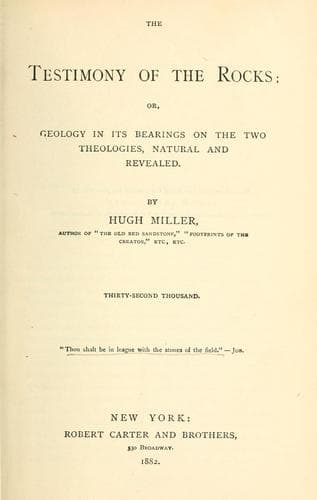
The Testimony of the Rocks: or, Geology in Its Bearings on the Two Theologies, Natural and RevealedMiller, Hugh
Philosophy
The Testimony of the Rocks: or, Geology in Its Bearings on the Two Theologies, Natural and Revealed
Miller, Hugh
Bible and geology; Creation; Religion and science
There are vertebrate animals of the second age of ichthyic existence,
that, like the _Pterichthys_ and _Coccosteus_, were furnished with but
two limbs. The murænidæ of recent times have no more; at least one of
their number, the muræna proper, wants limbs altogether; so also do the
lampreys. The snakes are equally limbless, save that the boas and
pythons possess the rudiments of a single pair; and such also is the
condition, among the amphibia, of all the known species of Coecilia.
And yet, notwithstanding these exceptional cases, the true typical
number of limbs, as shown by a preponderating majority of the
vertebrates of all ages of the world, is four. And this typical number
is the human number. There is as certainly a typical number of digits
too, as of the limbs which bear them. The exceptions are many. All the
species of the horse genus possess but a single digit; the cattle family
possess but two digits, the rhinoceros three digits, the hippopotamus
four digits; many animals, such as the dog and cat, have but four digits
on one pair of limbs and five on the other; whereas in some of the
fishes the number of digits is singularly great,--from ten to twenty in
most species, and in the rays from eighty to a hundred. And yet, as
shown in the rocks, in which, however, the aberrations appear early, the
true typical number is five on both the fore and hinder limbs. And such
is the number in man. There is also, in at least the mammalia, a typical
number of vertebræ in the neck. The three-toed sloth has nine cervical
vertebræ; the manati only six; but seven is the typical number. And
seven is the human number also. Man, in short, is pre-eminently what a
theologian would term the antetypical existence,--the being in whom the
types meet and are fulfilled. And not only do typical forms and numbers
of the exemplified character meet in man, but there are not a few parts
of his framework which in the inferior animals exist as but mere
symbols, of as little importance as dugs in the male animal, though they
acquire significancy and use in him. Such, for instance, are the
many-jointed but moveless and unnecessary bones of which the stiff
inflexible _fin_ of the dugong and the fore paw of the mole consist, and
which exist in his arm as essential portions, none of which could be
wanted, of an exquisitely flexible instrument. In other cases, the old
types are exemplified serially in the growth and development of certain
portions of his frame. Such is specially the case with that all
important portion of it, the organ of thought and feeling. The human
brain is built up by a wonderful process, during which it assumes in
succession the form of the brain of a fish, of a reptile, of a bird, of
a mammiferous quadruped; and, finally, it takes upon it its unique
character as a human brain. Hence the remark of Oken, that "man is the
sum total of all the animals;" hence, too, a recognition of type in the
_history_ of the successive vertebral periods of the geologist,
Public-domain text, read in full here on John Shaqi.
Reviews
Reviews
No reviews yet
Be the first to share your thoughts on this work.
Elsewhere in the archive
Join the Discussion
Join the discussion
Sign in to leave a comment or review.
Sign InorCreate an account