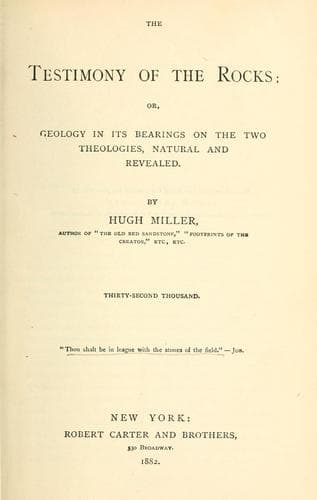
The Testimony of the Rocks: or, Geology in Its Bearings on the Two Theologies, Natural and RevealedMiller, Hugh
Philosophy
The Testimony of the Rocks: or, Geology in Its Bearings on the Two Theologies, Natural and Revealed
Miller, Hugh
Bible and geology; Creation; Religion and science
with a keel of lead, in order to render it sufficiently steady. The old
articulata abound in marks of ingenious mechanical contrivance. The
trilobites were covered over back and head with the most exquisitely
constructed plate armor: but as their abdomens seem to have been soft
and defenceless, they had the ability of coiling themselves round on the
approach of danger, plate moving on plate with the nicest adjustment,
till the rim of the armed tail rested on that of the armed head, and the
creature presented the appearance of a ball defended at every point. In
some genera, as in Calymene, the tail consisted of jointed segments till
its termination; in others, as in Illænus, there was a great caudal
shield, that in size and form corresponded to the shield which covered
the head; the segments of Calymene, from the flexibility of their
joints, fitted close to the cerebral rim; while the same effect was
produced in the inflexible shields, caudal and cephalic, of Illænus, by
their exact correspondence, and the flexibility of the connecting rings,
which enabled them to fit together like two equal-sized cymbals brought
into contact at every point by the hand. Nor were the ancient crinoids
less remarkable for the amount of nice contrivance which their
structures exhibited, than the ancient molluscs or crustaceans. In their
calyx-like bodies, consisting always of many parts, we find the
principle of the arch introduced in almost every possible form and
modification, and the utmost flexibility secured to their stony arms by
the amazing number of the pieces of which they were composed, and the
nice disposition of the joints. In the Pentacrinites of the Secondary
period (see Fig. 97) an immense spread of arms, about a thousand in
number, and composed of about a hundred thousand separate pieces, had
all the flexibility, though formed of solid lime, of a _drift_ of nets,
and yet were so nicely jointed, tooth fitting into tooth in all their
numerous parts, and the whole so bound together by ligament, that, with
all the flexibility, they had also all the toughness and tenacity, of
pieces of thread network. Human ingenuity, with the same purposes to
effect, that is, the sweeping of shoals of swimming animals into a
central receptacle, would probably construct a somewhat similar machine;
but it would take half a lifetime to execute one equally elaborate.
[Illustration: Fig. 94.
AMMONITES HUMPHRIESIANUS.
(_Oolite._)]
[Illustration: Fig. 95.
ENCRINITES MONILIFORMIS.
(_Trias._)]
[Illustration: Fig. 96.
CUPRESSOCRINUS CRASSUS.
(_Old Red Sandstone._)]
[Illustration: Fig. 97.[21]
PENTACRINUS FASCICULOSUS.
(_Lias._)]
[Illustration: Fig. 98.
_a_, CHAMFERED SCALES. (_Osteolepis._)
_b_, IMBRICATED SCALES. (_Glyptolepis._)
(_Old Red Sandstone._)]
Public-domain text, read in full here on John Shaqi.
Reviews
Reviews
No reviews yet
Be the first to share your thoughts on this work.
Elsewhere in the archive
Join the Discussion
Join the discussion
Sign in to leave a comment or review.
Sign InorCreate an account