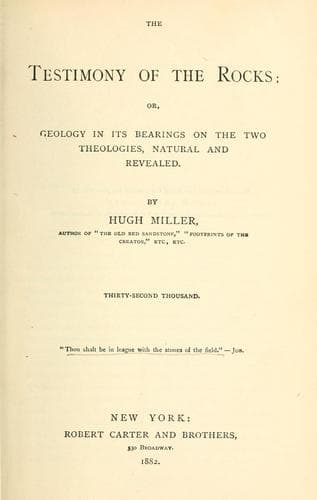
The Testimony of the Rocks: or, Geology in Its Bearings on the Two Theologies, Natural and RevealedMiller, Hugh
Philosophy
The Testimony of the Rocks: or, Geology in Its Bearings on the Two Theologies, Natural and Revealed
Miller, Hugh
Bible and geology; Creation; Religion and science
restoration,--set aside so long before,--as virtually the true one;--a
recognition in which Agassiz, when made acquainted with the nature of
the evidence, at once acquiesced. Now, here was there a question which
had been raised regarding the true mechanism of one of the oldest
ganoidal fishes, and settled erroneously on wrong data, again opened up,
to be settled anew on one of the most obvious mechanical principles
exemplified in the simple art of the slater or tiler. The argument of
Sir Philip amounted simply to this:--If the accepted restoration be a
true one, then the Creator of the Pterichthys must have committed a
mistake in mechanics which an ordinary slater would have avoided; but as
the Creator commits no such blunders, the mistake probably occurs in but
the restoration. I may mention, that the dorsal surface of this ancient
fish had also its central plate,--a lozenge truncated at its two longer
ends; and that, moulded to meet the necessities of its position, it was
not flat, like the under one, but strongly arched; and that on four of
its six sides it overrode by a squamose suture the lower plates with
which it came in contact.
These are but humble illustrations of the designing principle, as
exhibited of old; and yet they impress none the less strongly on that
account. Among the many contrivances of the Chinese Museum, to which I
have already referred, none seemed more to excite the curiosity of
visitors than a set of tall-backed, elaborately carved chairs,
exceedingly like those which were used in our own country two centuries
ago, and which Cowper so exquisitely describes. For thousands of miles
in the wide tract that spreads out between European Christendom and the
great wall, the inhabitants squat upon mats or carpets, or loll on
divans; and the contrivance of the chair is unknown: it reappears in
China, however, and reappears, not as a mere seat or stool, but as, in
every bar and limb, the identical chair of Europe arrested a century or
two back in its development. And every corresponding tenon and mortise
exhibited by the Chinese and European examples of this simple piece of
furniture served more forcibly to show an identity of character in the
minds which had originated them in countries so far apart, than the more
elaborate contrivances which, though illustrative of the same principles
of invention, were less easily understood. It is so with the more simple
and familiar instances of adaptation furnished by the works of the
Creator. We infer from them, more directly than from the complex
mechanisms, that he who wrought of old after the manner of a man must
have, in his intellectual character, if I may so express myself, certain
man-like qualities and traits. In all those works on Natural Theology
that treat, like the work of Paley, on the argument of design, the
assumption of a certain unity of the intellectual nature of the Creator
and creature is made, tacitly at least, the basis of all the reasonings;
Public-domain text, read in full here on John Shaqi.
Reviews
Reviews
No reviews yet
Be the first to share your thoughts on this work.
Elsewhere in the archive
Join the Discussion
Join the discussion
Sign in to leave a comment or review.
Sign InorCreate an account