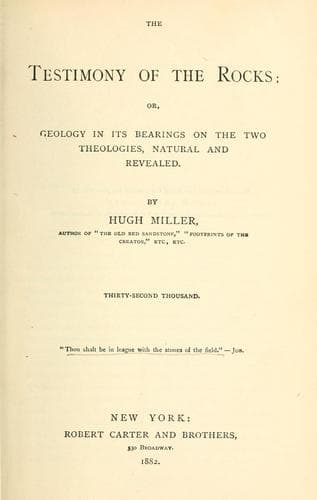
The Testimony of the Rocks: or, Geology in Its Bearings on the Two Theologies, Natural and RevealedMiller, Hugh
Philosophy
The Testimony of the Rocks: or, Geology in Its Bearings on the Two Theologies, Natural and Revealed
Miller, Hugh
Bible and geology; Creation; Religion and science
the paintings of ancient Egypt, are greatly faded. A few, however, of
the Secondary, and even Palæozoic shells, still retain the rich
prismatic hues of the original nacre. Many of the Tertiary division
still bear the distinctive painted spots. Some of the later fossil
fishes, when first laid open in the rock, exhibit the pearly gleam that
must of old have lighted up the green depths of the water as they darted
through. Not a few of the fossil corals preserve enough of their former
color to impart much delicacy of tint to the marbles in which they
occur. But it is chiefly in form, not in shade or hue, that we find in
the organisms of the geologic ages examples of that beauty in which man
delights, and which he is ever reproducing for himself. There is scarce
an architectural ornament of the Gothic or Grecian styles which may not
be found existing as fossils in the rocks. The Ulodendron was sculptured
into gracefully arranged rows of pointed and closely imbricated leaves,
similar to those into which the Roman architects fretted the torus of
the Corinthian order. The Sigillaria were fluted columns ornately
carved in the line of the channelled flutes; the Lepidodendra bore,
according to their species, sculptured scales, or lozenges, or egg-like
hollows, set in a sort of frame, and relieved into knobs and furrows;
all of them furnishing examples of a delicate diaper work, like that so
admired in our more ornate Gothic buildings, such as Westminster Abbey,
or Canterbury and Chichester Cathedrals, only greatly more exquisite in
their design and finish. The scroll shells, a very numerous section of
the class in the earlier ages, such as Maclurea, Euomphalus, Clymenia,
and the great family of the ammonites, were volutes of varying
proportions, but not less graceful than the ornament of similar
proportions so frequently introduced into Greek and Roman architecture,
and of which we have such prominent examples in the capitals of the
Ionic, Corinthian, and composite orders. In what is known as the modern
Ionic the spiral of the volute is not all on one plane; it is a
Euomphalus: in the central volutes of the Corinthian the spiral is an
open one; it is a Lituite or Gyroceras: in the ancient Ionic it is
either wholly flat, as in Planorbus or the upper side of Maclurea, or
slightly relieved, as in the ammonites. There is no form of the volute
known to the architect which may not be found in the rocks, but there
are many forms in the rocks unknown to the architect. Nor are the
spire-like shells (see Fig. 105) less remarkable for the rich and varied
style of their ornamentation than the whorled ones. They are spires,
pinnacles, turrets, broaches; ornate, in some instances, beyond the
reach of the architect, and illustrative, in almost all, of his happiest
forms and proportions. We detect among the fossils the germs of numerous
designs developed in almost every department of art; but merely to
enumerate them would require a volume.
Public-domain text, read in full here on John Shaqi.
Reviews
Reviews
No reviews yet
Be the first to share your thoughts on this work.
Elsewhere in the archive
Join the Discussion
Join the discussion
Sign in to leave a comment or review.
Sign InorCreate an account