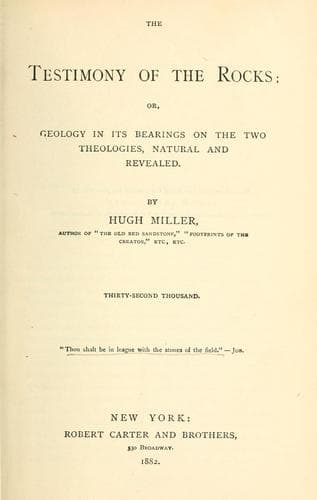
The Testimony of the Rocks: or, Geology in Its Bearings on the Two Theologies, Natural and RevealedMiller, Hugh
Philosophy
The Testimony of the Rocks: or, Geology in Its Bearings on the Two Theologies, Natural and Revealed
Miller, Hugh
Bible and geology; Creation; Religion and science
succession of individuals similar to and capable of reproducing each
other." "A _species_," says Cuvier, "is a succession of individuals
which reproduces and perpetuates itself."
Now, all history and all tradition, so far as they throw light on the
question at all, agree in showing that the centre in which the human
species originated must have been somewhere in the temperate regions of
the East, not far distant from the Caucasian group of mountains. All the
old seats of civilization,--that of Nineveh, Babylon, Palestine, Egypt,
and Greece,--are spread out around this centre. And it is certainly a
circumstance worthy of notice, and surely not without bearing on the
_physical_ condition of primeval humanity, that in this centre we find a
variety of the species which naturalists of the highest standing regard
as fundamentally typical of the highest races of the globe. "The
natives of the Caucasus," says Cuvier, "are even now considered as the
handsomest on earth." And wherever man has, if I may so speak, _fallen_
least,--wherever he has retained, at least intellectually, the Divine
image,--this Caucasian type of feature and figure, with, of course,
certain national modifications, he also retains. It was developed in a
remarkable degree among the old Greeks, as may be seen from the busts of
some of their handsomer men; and still more remarkably in their _beau
ideal_ of beauty, as exemplified in the statues of their gods. We see it
also, though dashed with a shade of severity, in the strong forms and
stern features of monarchs that reigned of old in Nineveh and Babylon,
as brought to light in their impressive effigies by the excavations of
Rawlinson and Layard. And further, though somewhat modified by the
African dash, we detect it in the colossal statues of Egypt. Nor, as
shown by Egyptian paintings still fresh in color and outline, was it
less traceable in the ancient Jewish countenance and figure. It is still
palpable, too, amid all the minor peculiarities of national physiognomy,
in the various peoples of Europe. We may see it in our own country,
though, as Sir Walter Scott truly tells us,--
"The rugged form may mark the mountain band,
And harsher features and a mien more grave."
Public-domain text, read in full here on John Shaqi.
Reviews
Reviews
No reviews yet
Be the first to share your thoughts on this work.
Elsewhere in the archive
Join the Discussion
Join the discussion
Sign in to leave a comment or review.
Sign InorCreate an account