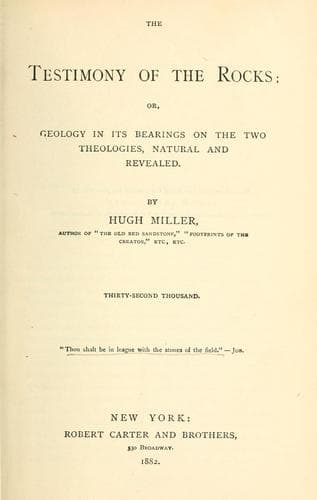
The Testimony of the Rocks: or, Geology in Its Bearings on the Two Theologies, Natural and RevealedMiller, Hugh
Philosophy
The Testimony of the Rocks: or, Geology in Its Bearings on the Two Theologies, Natural and Revealed
Miller, Hugh
Bible and geology; Creation; Religion and science
Let me next remark, that the further we remove from the original centre
of the race, the more degraded and sunk do we find the several varieties
of humanity. We must set wholly aside, in our survey, the disturbing
element of modern emigration. Caucasian man has been pressing outwards.
In the backwoods of America, in Southern Africa, in Australia, and in
the Polynesian islands, the old Adamic type has been asserting its
superiority, and annihilating before it the degraded races. But taking
into account merely the aboriginal varieties, it seems to be a general
rule, that the further we remove in any direction from the Adamic
centre, the more animalized and sunk do we find the various tribes or
races. Contrary to the conceptions of the assertors of the development
hypothesis, we ascertain, as we proceed outwards, that the course is not
one of progression from the low to the high, but of descent from the
high to the low. Passing northwards, we meet, where the lichen-covered
land projects into the frozen ocean, with the diminutive Laps, squat,
ungraceful, with their flat features surmounted by pyramidal skulls of
small capacity, and, as a race, unfitted for the arts either of peace or
war. We meet also with the timid Namollas, with noses so flat as to be
scarce visible in the women and children of the race; and with the
swarthy Kamtschatkans, with their broad faces, protuberant bellies, and
thin, ill-formed legs. Passing southwards, we come to the negro tribes,
with their sooty skins, broad noses, thick lips, projecting jawbones,
and partially-webbed fingers. And then we find ourselves among the
squalid Hottentots, repulsively ugly, and begrimmed with filth; or the
still more miserable Bushmen. Passing eastwards, after taking leave of
the Persian and Indian branches of the Caucasian race, we meet with the
squat Mongolian, with his high cheek bones set on a broad face, and his
compressed, unintellectual, pig-like eyes; or encounter, in the Indian
Archipelago or the Australian interior, the pitiably low Alforian races,
with their narrow, retreating foreheads, slim, feeble limbs, and
baboon-like faces. Or, finally, passing westward, we find the
large-jawed, copper-colored Indians of the New World, vigorous in some
of the northern tribes as animals, though feeble as men, but gradually
sinking in southern America, as among the wild Caribs or spotted
Araucans; till at the extremity of the continent we find, naked and
shivering among their snows, the hideous, small-eyed, small-limbed,
flat-headed Fuegians, perhaps the most wretched of human creatures. And
all these varieties of the species, in which we find humanity "fallen,"
according to the poet, "into disgrace," are varieties that have lapsed
from the original Caucasian type. They are all the descendants of man as
God created him; but they do not exemplify man as God created him. They
do not represent, save in hideous caricature, the glorious creature
moulded of old by the hand of the Divine Worker.
Public-domain text, read in full here on John Shaqi.
Reviews
Reviews
No reviews yet
Be the first to share your thoughts on this work.
Elsewhere in the archive
Join the Discussion
Join the discussion
Sign in to leave a comment or review.
Sign InorCreate an account