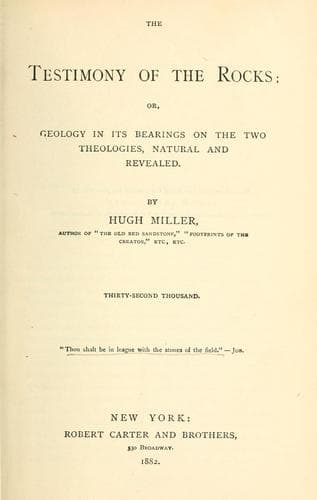
The Testimony of the Rocks: or, Geology in Its Bearings on the Two Theologies, Natural and RevealedMiller, Hugh
Philosophy
The Testimony of the Rocks: or, Geology in Its Bearings on the Two Theologies, Natural and Revealed
Miller, Hugh
Bible and geology; Creation; Religion and science
But if man, in at least the more degraded varieties of the race, be so
palpably _not_ what the Creator originally made him, by whom, then, was
he made the poor lost creature which in these races we find him to be?
He was made what he is, I reply, by man himself; and this, in many
instances, by a process which we may see every day taking place among
ourselves in individuals and families, though happily, not in races.
Man's nature again,--to employ the condensed statement of the poet,--has
been bound fast in fate, but his will has been left free. He is free
either to resign himself to the indolence and self-indulgence so natural
to the species; or, "spurning delights, to live laborious days;"--free
either to sink into ignorant sloth, dependent uselessness, and
self-induced imbecility, bodily and mental, or to assert by honest labor
a noble independence,--to seek after knowledge as for hidden treasures,
and, in the search, to sharpen his faculties and invigorate his mind.
And while we see around us some men addressing themselves with stout,
brave hearts to what Carlyle terms, with homely vigor, their "heavy job
of work," and, by denying themselves many an insidious indulgence, doing
it effectually and well, and rearing up well-taught families in
usefulness and comfort, to be the stay of the future, we see other men
yielding to the ignoble solicitations of appetite or of indolence, and
becoming worse than useless themselves, and the parents of ignorant,
immoral, and worse than useless families. The wandering vagrants of
Great Britain at the present time have been estimated at from fifteen to
twenty thousand souls; the hereditary paupers of England,--a vastly
more numerous class,--have become, in a considerable degree, a sept
distinct from the general community; and in all our large towns there
are certain per centages of the population,--unhappily ever increasing
per centages,--that, darkened in mind and embruted in sentiment, are
widely recognized as emphatically the dangerous classes of the
community. And let us remember that we are witnessing in these instances
no new thing in the history of the species: every period since that of
the vagabond Cain has had its waifs and stragglers, who fell behind in
the general march. In circumstances such as obtained in the earlier ages
of the human family, all the existing nomades and paupers of our country
would have passed into distinct races of men. For in the course of a few
generations their forms and complexions would begin to tell of the
self-induced degradation that had taken place in their minds; and in a
few ages more they would have become permanent varieties of the species.
There are cases in which not more than from two to three centuries have
been found sufficient thoroughly to alter the original physiognomy of a
race. "On the plantation of Ulster in 1611, and afterwards, on the
success of the British against the rebels in 1641 and 1689," says a
Public-domain text, read in full here on John Shaqi.
Reviews
Reviews
No reviews yet
Be the first to share your thoughts on this work.
Elsewhere in the archive
Join the Discussion
Join the discussion
Sign in to leave a comment or review.
Sign InorCreate an account