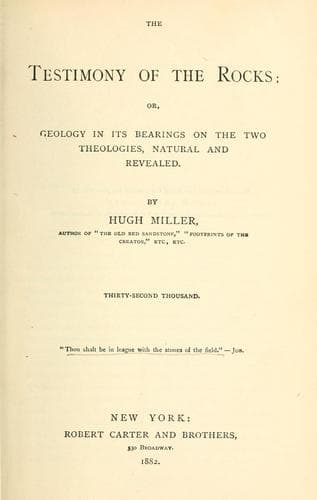
The Testimony of the Rocks: or, Geology in Its Bearings on the Two Theologies, Natural and RevealedMiller, Hugh
Philosophy
The Testimony of the Rocks: or, Geology in Its Bearings on the Two Theologies, Natural and Revealed
Miller, Hugh
Bible and geology; Creation; Religion and science
But the subject is one in which we can see our way as but "through a
glass darkly." Nay, it is possible that the master problem which it
involves no created intelligence can thoroughly unlock. It has been well
said, that the "poet's heart" is informed by a "terrible sagacity;" and
I am at times disposed to regard Milton's conception of the perplexity
of the fallen spirits, when reasoning on "fixed fate, free will,
foreknowledge absolute," and finding "no end in wandering mazes lost,"
much rather as a sober truth caught from the invisible world, than as
merely an ingenious fancy. The late Robert Montgomery has rather
unhappily chosen Satan as one of the themes of his muse; and in his long
poem, designated in its second title "Intellect without God," he has set
that personage a-reasoning in a style which, I fear, more completely
demonstrates the absence of God than the presence of intellect. It has,
however, sometimes occurred to me, that a poet of the larger calibre,
who to the Divine faculty and vision added such a knowledge of geologic
science as that which Virgil possessed of the Natural History of his
time, or as that which Milton possessed of the general learning of
_his_, might find, in a somewhat similar subject, the materials of a
poem which "posterity would not willingly let die." There is one of the
satirists justly severe on a class of critics
"Who, drily plain, without invention's aid,
Write dull receipts how poems may be made."
But at some risk of rendering myself obnoxious to his censure, I shall
attempt indicating at least the general scope and character of what the
schoolmen might term a _possible_ poem; which, if vivified by the genius
of some of the higher masters of the lyre, broad of faculty, and at once
great poets and great men, might prove one precious boon more to the
world, suited, conformably to the special demands of these latter times,
to
"assert Eternal Providence,
And justify the ways of God to man."
Public-domain text, read in full here on John Shaqi.
Reviews
Reviews
No reviews yet
Be the first to share your thoughts on this work.
Elsewhere in the archive
Join the Discussion
Join the discussion
Sign in to leave a comment or review.
Sign InorCreate an account