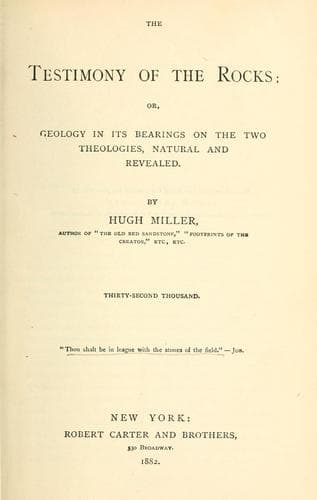
The Testimony of the Rocks: or, Geology in Its Bearings on the Two Theologies, Natural and RevealedMiller, Hugh
Philosophy
The Testimony of the Rocks: or, Geology in Its Bearings on the Two Theologies, Natural and Revealed
Miller, Hugh
Bible and geology; Creation; Religion and science
regards himself as sure of his position when he has _two_ landmarks to
determine it by, or when in the open ocean he can ascertain, not only
his latitude, but his longitude also. And this curious American
tradition seems to have its two such marks,--its two bisecting lines of
determination,--to identify it with the classic tradition of the Old
World that refers evidently to the same great event.
There are other portions of America in which the tradition of the Flood
is still more distinct than among the forests of the Orinoco. It is
related by Herrera, one of the Spanish historians of America, that even
the most barbarous of the Brazilians had some knowledge of a general
deluge; that in Peru the ancient Indians reported, that many years
before there were any Incas, all the people were drowned by a great
flood, save six persons, the progenitors of the existing races, who were
saved on a float; that among the Mechoachans it was believed that a
single family was preserved, during the outburst of the waters, in an
ark, with a sufficient number of animals to replenish the new world;
and, more curious still, that it used to be told by the original
inhabitants of Cuba, that "an old man, knowing the deluge was to come,
built a great ship, and went into it with his family and abundance of
animals; and that, wearying during the continuance of the flood, he sent
out a crow, which at first did not return, staying to feed on the dead
bodies, but afterwards returned bearing with it a green branch." The
resemblance borne by this last tradition to the Mosaic narrative is so
close as to awaken a doubt whether it may not have been but a mere
recollection of the teaching of some early missionary. Nor can its
genuineness now be tested, seeing that the race which cherished it has
been long since extinct. It may be stated, however, that a similar
suspicion crossed the mind of Humboldt when he was engaged in collecting
the traditions of the Indians of the Orinoco; but that on further
reflection and inquiry he dismissed the doubt as groundless. He even set
himself to examine whether the district was not a fossiliferous one, and
whether beds of sea shells, or deposits charged with the petrified
remains of corals or of fishes, might not have originated among the
aborigines some mere myth of a great inundation sufficient to account
for the appearances in the rocks. But he found that the region was
mainly a primary one, in which he could detect only a single patch of
sedimentary rock, existing as an unfossiliferous sandstone. And so,
though little prejudiced in favor of the Mosaic record, he could not
avoid arriving at the conclusion, simply in his character as a
philosophic inquirer, who had no other object than to attain to the real
and the true, that the legend of the wild Maypures and Tamanacs
regarding a great destructive deluge was simply one of the many forms of
that oldest of traditions which appears to be well nigh coextensive with
Public-domain text, read in full here on John Shaqi.
Reviews
Reviews
No reviews yet
Be the first to share your thoughts on this work.
Elsewhere in the archive
Join the Discussion
Join the discussion
Sign in to leave a comment or review.
Sign InorCreate an account