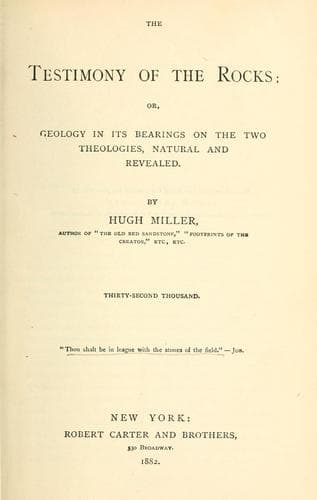
The Testimony of the Rocks: or, Geology in Its Bearings on the Two Theologies, Natural and RevealedMiller, Hugh
Philosophy
The Testimony of the Rocks: or, Geology in Its Bearings on the Two Theologies, Natural and Revealed
Miller, Hugh
Bible and geology; Creation; Religion and science
The inference here seems to be founded on a common but altogether
mistaken view of some of the grandest operations of nature with which
modern science has brought us acquainted. It has been well remarked,
that when two opposing explanations of extraordinary natural phenomena
are given,--one of a simple and seemingly common sense character, the
other complex and apparently absurd,--it is almost always safer to adopt
the apparently absurd than the seemingly common sense one. Dr. Kitto's
"plain man," yielding to the dictates of what he would deem common
sense,--which, of course, in questions of natural science is tantamount
to common nonsense,--would be sure to go wrong. And we find the remark
not inaptly illustrated by the now well established fact, that while the
medium level of the ocean is one of the most fixed lines in nature, the
level of the great continents, with their table-lands and mountains, is
an ever fluctuating line. It may seem strange that land should be less
stable than water. We see the tide rising and falling twice every
twenty-four hours, and the rock ever remaining in its place;--we speak
of the fixed earth and the unstable sea. And yet, while we have no
evidence whatever that the sea level has changed during at least the
ages of the Tertiary formations, and absolutely know that it could not
have varied more than a few yards, or at most a few fathoms, we have
direct evidence that during that time great mountain chains, many
thousand feet in height, such as the Alps, have arisen from the bottom
of the ocean, and that great continents have sunk beneath it and
disappeared. The larger part of northern Europe and America have been
covered by the sea since our present group of shells began to exist; and
it seems not improbable that the lower portion of the valley of the
Jordan was depressed to its present low level of thirteen hundred feet
beneath the Mediterranean since the times of the deluge. On several
parts of the coasts of Britain and Ireland the voyager can look down
through the clear sea, in depths to which the tide never falls, on the
remains of submerged forests; and it is a demonstrable fact, that even
during the present age there are certain extensive tracts of land which
have sunk beneath the sea level, while certain other extensive tracts
have been elevated over it. In 1819, a wide expanse of country in the
delta of the Indus, containing fully two thousand square miles of flat
meadow, was converted by a sudden depression of the land, accompanied by
an earthquake, into an inland sea; and the tower of a small fort, which
occupied nearly the middle of the sunken area, and on which many of the
inhabitants of a neighboring village succeeded in saving themselves, may
still be seen raising its shattered head over the surface,--the only
object visible in a waste of waters of which the eye fails to determine
the extent. About three years after this event, a tract of country,
Public-domain text, read in full here on John Shaqi.
Reviews
Reviews
No reviews yet
Be the first to share your thoughts on this work.
Elsewhere in the archive
Join the Discussion
Join the discussion
Sign in to leave a comment or review.
Sign InorCreate an account