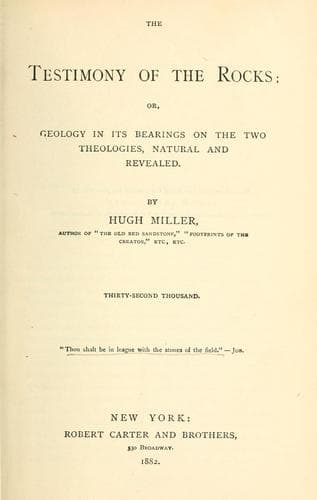
The Testimony of the Rocks: or, Geology in Its Bearings on the Two Theologies, Natural and RevealedMiller, Hugh
Philosophy
The Testimony of the Rocks: or, Geology in Its Bearings on the Two Theologies, Natural and Revealed
Miller, Hugh
Bible and geology; Creation; Religion and science
Let us, for the illustration's sake, suppose that the British islands
had been the scene of the Deluge; and that it had been occasioned by a
gradual depression in the earth's surface of about fifteen hundred miles
in length, a thousand miles in breadth, five thousand feet in depth in
its centre, and which gradually trended all around towards the sides.
Such a depression would form a scarce appreciable inequality on the
surface of even a three feet globe; in a twelve inch globe it might be
represented by the abrasion of a small patch of the varnish; nor would
it have in nature one sixth the depth, or one sixteenth the area, of the
bed of the Atlantic Ocean. Let us suppose further, that it had been
produced by an equable sinking of the surface, prolonged for forty days
at the rate of one hundred and twenty-five feet per day,--a motion not
equal to that of the minute-hand of a clock whose dial plate measures
two feet in diameter. Further, let us suppose that a thoroughly
intelligent man,--let us say Dr. Kitto himself,--secure from all
personal danger in an ark perched on some such commanding eminence as
Arthur's Seat, had been a witness of the catastrophe; and that, instead
of having merely to reason respecting it after the lapse of more than
four thousand years, he had been enabled to bear testimony regarding it
from the evidence of his senses. In the first place, let me remark that
the sinking or downward motion of the earth's crust would be altogether
inappreciable by sense; in the next, that the depression, even when it
had reached its acme, would in no sensible degree affect the contour of
surrounding objects. Even at the end of the forty days, when the five
thousand feet of depression had been reached, the gradient of
declination across the sunken area would not exceed _ten_ feet per mile,
and across the larger diameter would amount to but _six feet eight
inches_ per mile. Of course, at the end of the twentieth day the
gradients would be represented by but one half these sums, and would be
altogether inappreciable in the landscape; the hills would seem quite as
high as before, and the valleys not more profound. The only sensible
sign felt or visible of what was taking place would be simply a
persistent rising of the sea at somewhat less than twice its rate of
flow during stream tides. Ocean, as if forgetful of its ancient bounds,
would continue to encroach upon the land. On the second day the greater
part of what is now the site of Edinburgh would be covered; on the
seventh day the tide would have reached the vessel perched on the top of
the hill now known as Arthur's Seat; on the sixteenth day the highest
peak of the Pentlands would have disappeared; and in nine days more the
distant summit of Ben Lomond. From the roof of the slowly drifting ark
nothing would then have appeared save a shoreless ocean. But it would
have taken yet other eleven days ere the proud crest of Ben Nevis, the
Public-domain text, read in full here on John Shaqi.
Reviews
Reviews
No reviews yet
Be the first to share your thoughts on this work.
Elsewhere in the archive
Join the Discussion
Join the discussion
Sign in to leave a comment or review.
Sign InorCreate an account