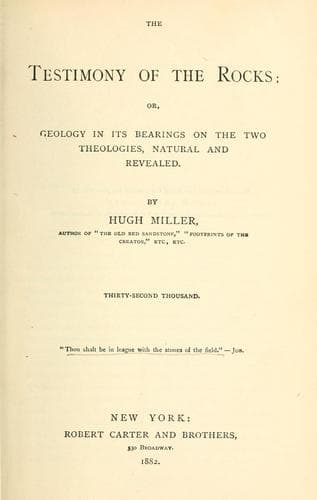
The Testimony of the Rocks: or, Geology in Its Bearings on the Two Theologies, Natural and RevealedMiller, Hugh
Philosophy
The Testimony of the Rocks: or, Geology in Its Bearings on the Two Theologies, Natural and Revealed
Miller, Hugh
Bible and geology; Creation; Religion and science
merely partial; and any such proof we may, with the good old Bishop of
Worcester, well "despair of ever seeing" produced. Even admitting,
however, for the argument's sake, that the inhabitants of the Old World
may have been as numerous as those of China are now,--a number estimated
by the recent authorities at more than three hundred and fifty
millions,--and the admission is certainly greatly larger than there is
argument enough on the other side to extort,--a comparatively partial
deluge would have been sufficient to secure their destruction. In short,
it may be fairly concluded, that if there be a show of reason against
the theory of a flood merely local, it has not yet been exhibited. Even
Dr. Kitto, with all his ingenuity and learning, has failed to array
against it arguments of any real weight or cogency; and in my next
address I may be perhaps able to show you that the objections which, on
the other hand, bear against the antagonist hypothesis, are at once
solid and numerous. I may be mistaken in my estimate; but for some years
past I have regarded them as altogether insurmountable.
LECTURE EIGHTH.
THE NOACHIAN DELUGE.
PART II.
A century has not yet gone by since all the organic remains on which the
science of Palæontology is now founded were regarded as the wrecks of a
universal deluge, and held good in evidence that the waters had
prevailed in every known country, and risen over the highest hills.
Intelligent observers were not wanting at even an earlier time who
maintained that a temporary flood could not have occasioned phenomena so
extraordinary. Such was the view taken by several Italian naturalists of
the seventeenth century, and in Britain by the distinguished
mathematician Hooke, the contemporary, and in some matters rival, of
Newton. But the conclusions of these observers, now so generally
adopted, were regarded both in Popish and Protestant countries as but
little friendly to Revelation; and so strong was the opposite opinion,
and so generally were petrifactions regarded as so many proofs of a
universal deluge, that Voltaire felt himself constrained, first in his
Dissertation drawn up for the Academy at Bologna, and next in his
article on shells in the Philosophical Dictionary, to take up the
question as charged with one of the evidences of that Revelation which
it was the great design of his life to subvert. And with an unfairness
too characteristic of his sparkling but unsolid writings, we find him
arguing, that all fossil shells were either those of fresh water lakes
and rivers evaporated during dry seasons, or of land snails developed in
unusual abundance during wet ones; or that they were shells which had
been dropped from the hats of pilgrims on their way from the Holy Land
to their homes; or that they were shells that had gone astray from
cabinets and museums; or, finally, that they were not shells at all, but
mere shell-like forms, produced by some occult process of nature in the
bowels of the earth.
Public-domain text, read in full here on John Shaqi.
Reviews
Reviews
No reviews yet
Be the first to share your thoughts on this work.
Elsewhere in the archive
Join the Discussion
Join the discussion
Sign in to leave a comment or review.
Sign InorCreate an account