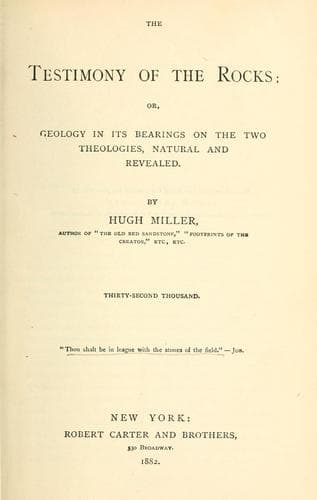
The Testimony of the Rocks: or, Geology in Its Bearings on the Two Theologies, Natural and RevealedMiller, Hugh
Philosophy
The Testimony of the Rocks: or, Geology in Its Bearings on the Two Theologies, Natural and Revealed
Miller, Hugh
Bible and geology; Creation; Religion and science
When Brahma, wearied with the work of producing and maintaining the
universe, goes to sleep, say the Hindus,--an occurrence which happens at
the end of every four millions of years,--a deluge of water rises high
above the sun and moon, and the worlds and their inhabitants are
destroyed. When he awakes, however, he immediately sets himself to
produce anew; and another universe springs up, consisting, like the
former one, of ten worlds placed over each other, like the stories of a
tall building, and replenished with plants and animals. Of these our own
world is the eighth in number, reckoning from the ground floor upwards;
there are seven worlds worse than itself beneath it, and two better ones
above; with a few worlds more higher up still, to which the destroying
flood does not reach, save once or twice in an eternity or so; and
which, in consequence, have not to be re-created each time with the
others. The special forms which the upper and nether worlds exhibit do
not seem to be very well known; but that which man inhabits is "flat,
like the flower of the water-lily, in which the petals project beyond
each other;" and it has in all, including sea and land, a diameter of
several hundred thousand _millions_ of miles. It has its many great
oceans,--one of these (unfortunately the only one in contact with man's
place of habitation) of salt water, one of sugar-cane juice, one of
spirituous liquor, one of clarified butter, and one of sour curds. It
has, besides, its very great ocean of sweet water. And around all,
forming a sort of gigantic hoop or ring, there extends a continent of
pure gold. Of all the luminaries that rise over this huge world, the sun
is the nearest: the distance of the moon is twice as great; the lesser
fixed stars occur immediately beyond; then Mercury, then Venus, then
Mars, then Jupiter, then Saturn; and finally, the great bear and the
polar star. And such is that cosmogony and astronomy of the Brahmins to
which their religion, in its character as a revelation, stands
committed, and in which a very lenient criticism has found the geologic
revolutions. Let me draw my next illustration from Buddhism, the most
ancient and most widely spread religion of the East; for, though
partially overlaid in the great Indian peninsula by the more modern
monstrosities of Brahminism, it extends in one direction from the
Persian Gulf to Formosa and Japan, and in the other from the wastes of
Siberia to the Gulf of Siam. Scarce any of the other forms of heathenism
darken so large a portion of the map as Buddhism,--a superstition which
is estimated to include within its pale nearly one third of the whole
human species.
Public-domain text, read in full here on John Shaqi.
Reviews
Reviews
No reviews yet
Be the first to share your thoughts on this work.
Elsewhere in the archive
Join the Discussion
Join the discussion
Sign in to leave a comment or review.
Sign InorCreate an account