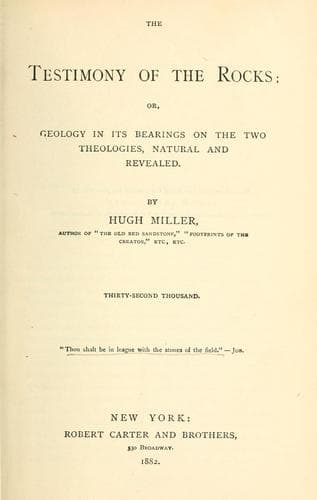
The Testimony of the Rocks: or, Geology in Its Bearings on the Two Theologies, Natural and RevealedMiller, Hugh
Philosophy
The Testimony of the Rocks: or, Geology in Its Bearings on the Two Theologies, Natural and Revealed
Miller, Hugh
Bible and geology; Creation; Religion and science
It is of first importance often to the navigator that he should have a
good chronometer, seeing that his ability of determining his exact
position on wide seas, and, in consequence, of determining also the
exact place and bearing of the rocks and reefs which he must avoid, and
of the lands and harbors on which he must direct his course, must very
much depend upon the rectitude of his instrument. But it may be of very
little importance to him to know how chronometers are made. And so a
friend may reveal to him where the best chronometers are to be
purchased, with the name of the maker, without at the same time
revealing to him the principle on which they are constructed. Let us
suppose, however, that from some peculiarity in the mode of the
revelation, the navigator has come to believe that it includes both
items,--an enunciation regarding the place where and the maker from
whom the best chronometers are to be had, and a further enunciation
regarding the true mechanism of chronometers. Let us suppose further,
that while the good faith and intelligence of his friend are
unquestionable, the supposed revelation regarding the construction of
chronometers, which he thinks he owes to him, is altogether erroneous
and absurd. The chronometer mainly differs from the ordinary watch in
being formed of a mixture of metals, which preserve so nice a chemical
balance, that those changes of temperature which quicken or retard the
movements of common time-pieces fail to affect it. Now, let us suppose
that the friend and adviser of the sailor had said to him,--using a
common metonymy,--there are no chronometers anywhere constructed that so
_completely neutralize the temperature_ as the ones I recommend to you;
and that the sailor had at once leaped to the conclusion, that the
remark was authority enough for holding that it is the principle of
chronometers, not to be composed of such counteractive combinations of
metals as that the expansion of one shall be checked by the contraction
of another, but to keep up an equal temperature within through a
heat-engendering quality in the amalgamated metals. Such a mistake might
be readily enough originated in this way; and yet it would be a very
serious mistake indeed; seeing that it would substitute an active for a
passive principle,--a principle of equalizing the temperature by acting
upon it, for a principle of inert impassibility to the temperature. And
of course not only would the sailor himself be in error in taking such a
view, but he might seriously compromise the intelligence or integrity of
his friend in the judgment of all who held, on his testimony, that it
was with his friend, and not from his own misconception of his friend's
meaning, that the view had originated. And how, let us ask, ere
dismissing our lengthened illustration, is an error such as the
supposed one here to be tested, and its erroneousness exposed? There can
be but one reply to such a query. It might be wholly in vain to fall
Public-domain text, read in full here on John Shaqi.
Reviews
Reviews
No reviews yet
Be the first to share your thoughts on this work.
Elsewhere in the archive
Join the Discussion
Join the discussion
Sign in to leave a comment or review.
Sign InorCreate an account