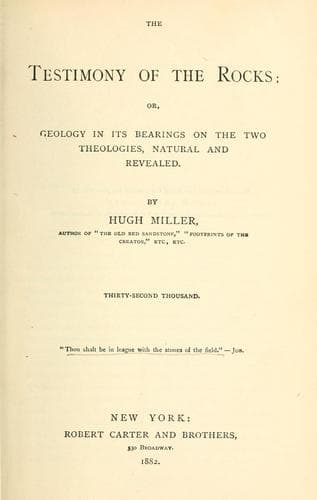
The Testimony of the Rocks: or, Geology in Its Bearings on the Two Theologies, Natural and RevealedMiller, Hugh
Philosophy
The Testimony of the Rocks: or, Geology in Its Bearings on the Two Theologies, Natural and Revealed
Miller, Hugh
Bible and geology; Creation; Religion and science
Now this I must regard as a passage as instructive as it is
extraordinary. Turrettine was one of the most accomplished theologians
of his age; nor is that age by any means a remote one. Tycho Brahe,
Kepler, and Galileo, had all finished their labors long ere he published
this passage; nay, at the time when his work issued from the Amsterdam
press (1695), Isaac Newton had attained his fifty-third year; and fully
ten years previous, Professor David Gregory, nephew of the inventor of
the Gregorian telescope, had begun to teach, from his chair in the
University of Edinburgh, the doctrine of gravitation and the true
mechanism of the heavens, as unfolded in the Newtonian philosophy. The
learned theologian, had he applied himself to astronomical science,
could have found at the time very enlightened teachers; but falling into
exactly the mistake of the sailor of my illustration, or that into
which, two centuries before, the doctors of Salamanca had fallen, he set
himself, instead, to contend with the astronomers, and, to the extent of
his influence, labored to pledge revelation to an astronomy as false as
that of the Buddhist, Hindu, or old Teuton. His mistake, I repeat, was
exactly that of the sailor. Though in the Scriptures only the fact of
the _authorship_ of the great chronometer set in the heavens "to be a
sign for seasons, and for days and years," is revealed, he regarded
himself as also informed respecting the principles on which the
chronometer was constructed, or at least respecting the true nature of
its movements; and several very important deductions may, I think, be
drawn from the carefully constructed passage in which he so unwittingly
records his error, and the grounds of it. In the first place, we may
safely hold that the texts of Scripture quoted by so able a theologian
are those which have most the appearance of being revelations to men
respecting the motions of the heavenly bodies. We may conclusively
infer, that if _they_ do not reveal the character of those motions, then
nowhere in Scripture is their character revealed. In the second place,
it is obvious that the cited texts do _not_ reveal the nature of the
motions. It would be as rational to hold that our best almanacs reveal
the Ptolemaic astronomy. In the scientific portion of our almanacs there
occur many phrases which are perfectly well understood, and indicate
very definitely what the writer really intends to express by them, that
yet, taken literally, are not scientifically true. The words, "Sun
rises," and "Sun sets," and "Moon rises," and "Moon sets," occur in
every page; there are two pages--those devoted to the months of March
and September--in which the phrase occurs, "Sun crosses the equinoctial
line;" and further, in the other pages, such phrases as "Sun enters
Aries," "Sun enters Taurus," "Sun enters Gemini," &c., &c., are not
unfrequent. The phrase, "new moon," is also of common occurrence. And
Public-domain text, read in full here on John Shaqi.
Reviews
Reviews
No reviews yet
Be the first to share your thoughts on this work.
Elsewhere in the archive
Join the Discussion
Join the discussion
Sign in to leave a comment or review.
Sign InorCreate an account