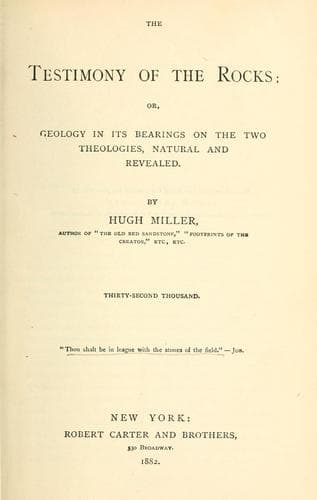
The Testimony of the Rocks: or, Geology in Its Bearings on the Two Theologies, Natural and RevealedMiller, Hugh
Philosophy
The Testimony of the Rocks: or, Geology in Its Bearings on the Two Theologies, Natural and Revealed
Miller, Hugh
Bible and geology; Creation; Religion and science
Let me remark in the passing, that while Turrettine, one of the
greatest of theologians, failed, as we have seen, to find in Scripture
the fact of astronomic _construction_, La Place, one of the greatest of
the astronomers, failed in a manner equally signal to find in his
science the fact of astronomic _authorship_. The profound Frenchman
(whom Sir David Brewster well characterizes as "the philosopher to whom
posterity will probably assign the place next to Newton "), by
demonstrating that certain irregularities in the motion of the heavenly
bodies, which had been supposed to indicate a future termination to the
whole, were but mere oscillations, subject to periodic correction, and
indicative of no such termination in consequence, demonstrated also
that, from all that appears, the present astronomical movements might go
on forever. And as he could find in the solar system no indications of
an end, so was he unable, he said, to find in it any trace of a
beginning. He failed in discovering in all astronomy the fact of
authorship, just as Turrettine had failed in finding in all Scripture
the fact of astronomic construction. And here lies, I am inclined to
think, the true line between revelation and science,--a line drawn of
old with a God-derived precision, which can be rightly appreciated
neither by mere theologians like Turrettine, nor by mere men of science
like La Place, but which is notwithstanding fraught with an evidence
direct in its bearing on the truth of Scripture. That great fact, moral
in its influence, of the authorship of the heavens and earth, which the
science of La Place failed of itself to discover, and which was equally
unknown to the ancient philosophers, God has revealed. It is "through
faith we understand that the worlds were formed by the word of God, so
that things which are seen were not made of things which do appear."
And, on the other hand, the great truths, physical in their bearing, to
the discovery of which science is fully competent, God did not reveal,
but left them to be developed piecemeal by the unassisted human
faculties. And that ability of nicely drawing the line between the two
classes of truths in a very remote age of the world, which we find
manifested in the oldest of the Scriptural books, I must regard as an
ability which could have been derived only through inspiration, and from
God alone.
Public-domain text, read in full here on John Shaqi.
Reviews
Reviews
No reviews yet
Be the first to share your thoughts on this work.
Elsewhere in the archive
Join the Discussion
Join the discussion
Sign in to leave a comment or review.
Sign InorCreate an account