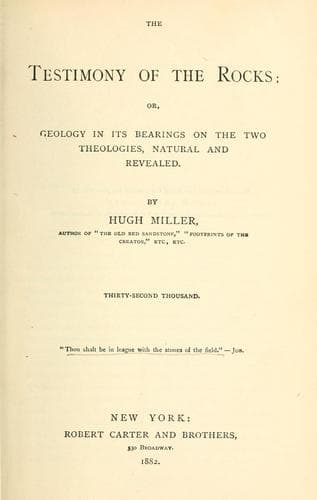
The Testimony of the Rocks: or, Geology in Its Bearings on the Two Theologies, Natural and RevealedMiller, Hugh
Philosophy
The Testimony of the Rocks: or, Geology in Its Bearings on the Two Theologies, Natural and Revealed
Miller, Hugh
Bible and geology; Creation; Religion and science
We inquire whether, in its leading features, the Mosaic
does not correspond with the geologic record; and whether the _days_ of
the retrospective prophecy of creation are to be regarded as coextensive
with the vast periods of the geologist, or as merely representative
portions of them, or as literal days of twenty-four hours each? But
though we thus seek to harmonize the two records, we continue to regard
their grounds and objects as entirely different. The object of geology
is simply the elucidation of the history of the earth, and of the story
of its various creations; and its grounds are, like those of astronomy
or geography, or of any other physical science, facts and inferences
scientifically determined or deduced; while, on the other hand, the
grounds of the Mosaic record are those on which the other Scriptures
rest, and which have been so well laid down in what we may term the
higher literature of the "Evidences," while at least some of its
objects,--for who shall declare them all?--seem to be, first, to
establish the all-important fact of the Divine authorship of the
universe, and to show that all its various forces are not self-existent,
but owe their origin to a Great First Cause; next, to exhibit the
progressive character of God's workings,--a character which equally
applies to his works of creation and providence; and, in the third
place, to furnish a basis and precedent, in the Divine example, for that
institution of the Sabbath which bears not only a prophetic reference to
the great dynasty to come,--last of all the dynasties, and of which
re-created men are to be the happy subjects, and the Divine Man the
adorable Monarch,--but which has also been specially established in
order that right preparation may be made for the terminal state which it
symbolizes and foreshadows. Here, as certainly as in the other physical
sciences, the line has been drawn with perfect precision between what
man could and what he could not have known of himself. What he could
have known, and in part already knows, is geologic science; what in all
probability he never could have known is the fact of the Divine
authorship of the universe, and the true nature of the institution of
the Sabbath, as a time of preparation for the final state, and as alike
representative of God's workings in the past, and of his eternally
predetermined scheme for the future. "Is it not certain," Socrates is
represented as inquiring, in "the first Alcibiades," of his gay and
confident pupil, "that you know nothing but what has been told you by
others, or what you have found out for yourself?" There is at once
exquisite simplicity and great terseness in this natural division of the
only modes in which men can acquire knowledge; and we find it
wonderfully exemplified in all revelation. Scripture draws practically a
broad line between the two modes; and while it tells man all that is
necessary to his wants and welfare as a religious creature, it does not
Public-domain text, read in full here on John Shaqi.
Reviews
Reviews
No reviews yet
Be the first to share your thoughts on this work.
Elsewhere in the archive
Join the Discussion
Join the discussion
Sign in to leave a comment or review.
Sign InorCreate an account