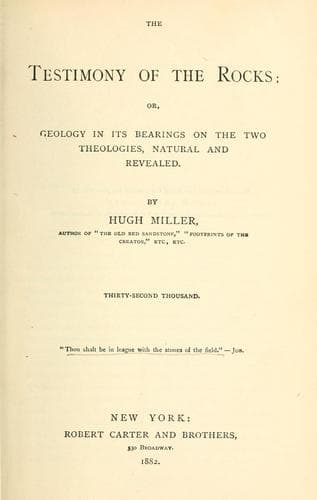
The Testimony of the Rocks: or, Geology in Its Bearings on the Two Theologies, Natural and RevealedMiller, Hugh
Philosophy
The Testimony of the Rocks: or, Geology in Its Bearings on the Two Theologies, Natural and Revealed
Miller, Hugh
Bible and geology; Creation; Religion and science
Tested by their reading of the phenomena on this principle, we find
curious gradations between the higher and the humbler orders of minds.
The vortices of Descartes, for instance, involve but a simple idea, that
might have been struck out by almost any individual of a tolerably
lively fancy, who had walked by the side of a winding river, and seen
sticks and straws revolving in its eddies. But no fancy, however active,
or no reach of mere common sense, however respectable, could have
originated, or conducted to a successful conclusion, that profound
contemplation into which Newton fell in the garden of Woolsthorpe, when
he saw the loosened apple drop from the tree, and succeeded in
demonstrating that the planets are retained in their orbits by the same
law which impels a falling pebble towards the ground. So little obvious,
indeed, was the Newtonian scheme, that most of the contemporary
generation of philosophers,--some of them, such as Fontenelle and his
brother academicians of France, men of no mean standing,--died rejecting
it. And the objections of Turrettine to the motion of the earth on its
axis are, we find, still more obvious than even the idea of the
vortices. It does at first seem natural enough to suppose, that if the
earth's surface be speeding eastwards at the rate of several hundred
miles in the hour (a thousand miles at the equator), the birds which
flutter over it should be somewhat in danger of being left behind; and
that atoms and down flakes floating in the atmosphere in a time of calm,
instead of appearing, as they often do, either in a state of rest, or
moving with equal freedom in every direction, ought to be seen hurrying
westwards, as if puffed by the breath of a tornado. Such an objection
must for a time have appeared as just as it seems obvious, especially in
one's study on a Saturday night, with much of one's lecture still to
write, and the Sabbath too near to permit of verification or experiment.
Fontenelle, however, though he could not get over the difficulty of
conceiving how the same gravitation which made a stone fall also kept
the moon in its place, fairly surmounted that which puzzled Turrettine;
and in his "Plurality of Worlds,"--a publication of the same age as the
"Compendium Theologica,"--he makes his Marchioness surmount it too.
"'But I have a difficulty to solve,' he represents the lady as saying,
'and you must be serious. As the earth moves, the air changes every
moment; so we breathe the air of another country.' 'Not at all,' replied
I; 'for the air which encompasses the earth follows with us, and turns
with us. Have you not seen the labors of the silkworm? The shell or
cocoon which it weaves around itself with so much art is of a down very
loose and soft; and so the earth, which is solid, is covered, from the
surface twenty leagues upwards, with a kind of down, which is the air,
and, like the shell of the silkworm, turns along with it.'" Even
Public-domain text, read in full here on John Shaqi.
Reviews
Reviews
No reviews yet
Be the first to share your thoughts on this work.
Elsewhere in the archive
Join the Discussion
Join the discussion
Sign in to leave a comment or review.
Sign InorCreate an account