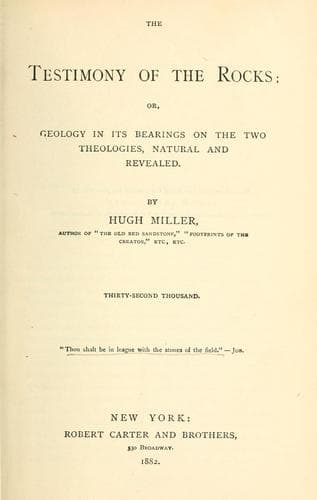
The Testimony of the Rocks: or, Geology in Its Bearings on the Two Theologies, Natural and RevealedMiller, Hugh
Philosophy
The Testimony of the Rocks: or, Geology in Its Bearings on the Two Theologies, Natural and Revealed
Miller, Hugh
Bible and geology; Creation; Religion and science
Let me first remark, that no one need expect to be original simply by
being absurd. There is a cycle in nonsense, as certainly as in opinion
of a more solid kind, which ever and anon brings back the delusions and
errors of an earlier time: the follies of the present day are
transcripts, unwittingly produced, and with of course a few variations,
of follies which existed centuries ago; and it seems to be on this
principle,--a consequence, mayhap, of the limited range of the human
mind, not only in its elucidations of truth, but also in its forms of
error,--that scarce an explanation of geologic phenomena has been given
by the anti-geologists of our own times, that was not anticipated by
writers of the sixteenth and seventeenth centuries. It was held, for
instance,--in opposition to the great painter, Leonardo da Vinci, who
flourished early in the sixteenth century, and was one of the first who,
after the revival of learning, asserted the true character of organic
remains,--that fossils were formed in the rocks through the planetary
influences, or a certain plastic force in nature, and had never entered
into the composition of living creatures or plants. And this view
obtained very generally till about the middle of the seventeenth
century, when, save for a brief space long after, in the times of
Voltaire, it ceased to be regarded as any longer tenable. Curiously
enough, however, it was virtually reproduced by one of the extant
anti-geologists,--a clergyman of the English Church,--only three years
ago, in a publication written, he says, to counteract "the immense
mischief occasioned by the infidel works of geologists, _especially
among the lower classes_," and which he has termed "a brief and complete
refutation" of their "anti-scriptural theory."[37] "Fossils," says this
courageous writer, "were not necessarily animated structures:" some of
them were in all probability "formed of stone from the very first;"
others, of inanimate flesh and bone. "The mammoth found under the ice in
arctic regions had not necessarily been a living creature: it was
created under the ice, and then preserved in that peculiar form of
preservation, instead of being transmuted into stone, like the rest of
its class." Such was the state of keeping of this famous mammoth, when
discovered a little ere the beginning of the present century, that, as I
had occasion formerly to remark, dogs and bears fed upon its flesh; and
its bones, and part of its skin, covered with long red hair, are now in
the museum of Petersburg. But there is no evidence whatever, according
to this writer, that it had ever been a living creature: it was simply a
created carcass. All organisms are, he holds, models or archetypes,
fashioned during the first day in the depths of chaos, to typify or
foreshadow the living plants and animals that were to be called into
existence a few days later. "What," he asks, "do the cocoa-nuts, melons,
and gourds, which have been found in the strata, show, but that the
Public-domain text, read in full here on John Shaqi.
Reviews
Reviews
No reviews yet
Be the first to share your thoughts on this work.
Elsewhere in the archive
Join the Discussion
Join the discussion
Sign in to leave a comment or review.
Sign InorCreate an account