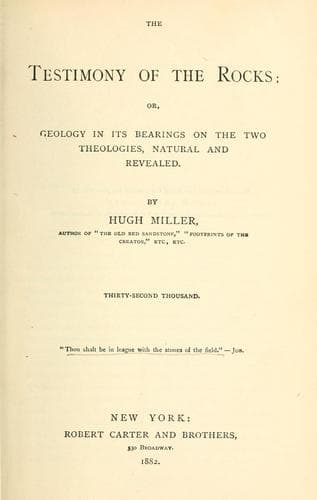
The Testimony of the Rocks: or, Geology in Its Bearings on the Two Theologies, Natural and RevealedMiller, Hugh
Philosophy
The Testimony of the Rocks: or, Geology in Its Bearings on the Two Theologies, Natural and Revealed
Miller, Hugh
Bible and geology; Creation; Religion and science
instances of reasoning, directed by the anti-geologists _against_ their
antagonists (as they themselves believed), but which, from their
ignorance of the true state of the argument, and of the bearing of the
facts with which they dealt, in reality made out for these antagonists
as strong a case as they could possibly have made out for themselves.
And I am sure that, rather than be found siding with their opponents,
the anti-geologists would be content even to acquire a little geology.
I shall select my first instance from the records of the annual
controversy which used to rage some ten or fifteen years ago, in
sermons, newspapers, and magazines, immediately after every meeting of
the British Association. A religious Dublin newspaper,--the "Statesman
and Record,"--since extinct, took always an active part in these
discussions on the anti-geological side, and boldly affirmed, as in a
number now before me, that geology had the devil for its author. A
learned correspondent of the paper, who was, however, somewhat more
charitable, thought that at least the _facts_ of the science might be
exempted from a condemnation so sweeping; nay, that, well interpreted,
they might be found decidedly opposed to at least the more mischievous
deductions of the geologists; and in illustrating the point, we find him
thus arguing, from certain appearances in the valley of the Nile, that
the globe which we inhabit cannot possibly be more than six thousand
years old.[42] "The valley of the Nile," says this writer, "is known to
be covered with a bed of slime which the river has deposited in its
periodical inundations, and which rests on a foundation of sand, like
that of the adjacent desert. The French savans who accompanied Bonaparte
in his Egyptian expedition made several experiments to ascertain the
thickness and depth of this superincumbent bed. They dug about two
hundred pits, and carefully measured the thickness in the transversal
section of the valley, where the deposit had been free from obstacles,
and had not been materially increased or lessened by local causes. They
found the mean of all these measurements to be six and a half metres, or
rather more than twenty feet. M. Gironde endeavored to determine the
quantity of slime deposited in a century; and he found that the
elevation of soil in that period was rather less than four inches and a
half! Dividing the total thickness of the bed by the centenary
elevation, he found the quotient 56.50; whence it followed that the
inundations had commenced 5650 years before the year 1800, when the
experiments were made,--a number which only differed 159 years from the
Mosaic date. The difference is not very important, when it is considered
that the most trifling error, whether in the measure of the entire
superincumbent bed, or in the valuation of the quantity of slime
deposited in a century, affects the final results. Notwithstanding this,
the coincidence between the sacred historian and the computations of
Public-domain text, read in full here on John Shaqi.
Reviews
Reviews
No reviews yet
Be the first to share your thoughts on this work.
Elsewhere in the archive
Join the Discussion
Join the discussion
Sign in to leave a comment or review.
Sign InorCreate an account