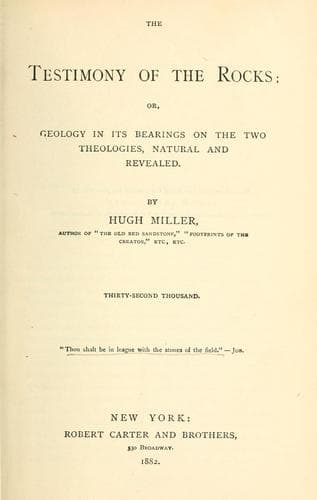
The Testimony of the Rocks: or, Geology in Its Bearings on the Two Theologies, Natural and RevealedMiller, Hugh
Philosophy
The Testimony of the Rocks: or, Geology in Its Bearings on the Two Theologies, Natural and Revealed
Miller, Hugh
Bible and geology; Creation; Religion and science
to the Arabs as "Pharaoh's beans;" and these organisms stand out in high
relief on the weathered portions of the Great Sphinx. Some of the oldest
things in the world in their relation to human history,--erections, many
of which had survived the memory of their founders even in the days of
Herodotus,--are formed of materials so modern in their relation to the
geologic epochs, that they had no existence as rock until after the
Palæozoic and Secondary ages had gone by. Not only the Carboniferous
sandstone of the High Church and Parliament House of Edinburgh, but even
the Oolitic (that is, Portland stone) of Somerset House and St. Paul's,
are of an antiquity incalculably vast compared with the stone out of
which the oldest of the pyramids were fashioned.
[Illustration: Fig. 116.
NUMMULITES LÆVIGATA.
(_Pharaoh's Beans._)]
The second example which I shall adduce is one with which many of my
auditors must be already familiar. The Falls of Niagara are gradually
eating their way through an elevated tract of table-land, upwards
towards Lake Erie, at the rate of about fifty yards in forty years; and
it has been argued by Sir Charles Lyell, that as they are now seven
miles distant from Queenston, where the elevation of the plateaux
begins, they must have taken about ten thousand years to scoop out their
present deep channel through that space.[43] Ten thousand years ago the
Falls were, he infers, at Queenston; and the grounds on which he reasons
are exactly those on which one would infer that a laborer who had cut a
ditch two hundred yards long at the rate of ten yards per day, and was
still at work without pause or intermission, had begun to cut it just
twenty days previous. A reverend anti-geologist takes up Sir
Charles;[44] and, after denouncing the calculation as "a stab at the
Christian religion," seeing it involves the assertion that the "Falls
were actually at Queenston four thousand years before the creation of
the world according to Moses," he brings certain facts, adduced both by
other writers and Sir Charles himself, to bear on the calculation, such
as the fact that the deep trench through which the Niagara runs is much
narrower in its lower than in its upper reaches, and that the river must
have performed its work of excavation, when the breadth was less, at a
greatly quicker rate than now. And thus the work of excavating the
trench is brought fairly within six thousand years. Nor is the principle
of the reasoning bad. In our illustration of the ditch excavated by the
laborer we of course take it for granted that it is a ditch of the same
depth and breadth throughout, and excavated in the same sort of soil;
for if greatly narrower and shallower at one place than at another, or
dug in a greatly softer mould, the rate of its excavation at different
times might be very different indeed, and the general calculation widely
erroneous, if based on the ratio of progress when it went on most
slowly, taken as an average ratio for the whole.
Public-domain text, read in full here on John Shaqi.
Reviews
Reviews
No reviews yet
Be the first to share your thoughts on this work.
Elsewhere in the archive
Join the Discussion
Join the discussion
Sign in to leave a comment or review.
Sign InorCreate an account