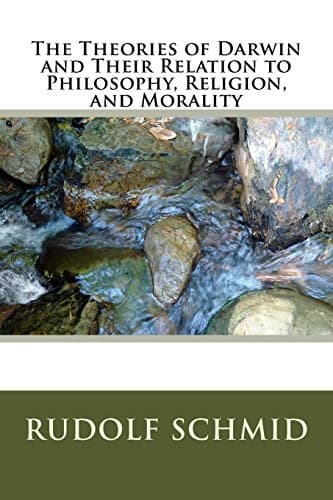
The Theories of Darwin and Their Relation to Philosophy, Religion, and MoralitySchmid, Rudolf
Religion
The Theories of Darwin and Their Relation to Philosophy, Religion, and Morality
Schmid, Rudolf
Evolution; Religion and science
Wilhelm Bleek, in the preface to his "Ursprung der Sprache" ("Origin of
Language"), rejects all claims of a positively revealed religion to an
objective truth--not in such a way as to substitute the universe in place
of God, but so that he remains sceptical in reference to every attempt at
forming an idea of God, demands a pious and modest confession of this
non-understanding by man, and sees in this reverential modesty the
certainly not very significant nature of his religion. In the preface he
says that all worship originates in reverence for ancestors, and that even
the doctrine of the atonement of modern theology has its origin there. The
next step after reverence for ancestors was the worship of nature. But the
grand turning-point at which the mythological mode of view gives way--in
which mode of view he also reckons Christianity--is the giving up of the
idea of the necessity of an atonement; for this whole idea is but
anthropomorphism. It is when man has recognized the impossibility of a
being, similar to man, as the final cause of all existences, and in
reverential modesty has admitted his ignorance in reference to the nature
of the origin of things, that he learns to understand how narrow a view he
has of God when he thinks that he understands him.
On the side of philosophy, Albert Lange and Herbert Spencer reach similar
results. Albert Lange, in his {195} "History of Materialism," starting
especially from premises of Kant, reaches the conclusion that the "thing
_per se_," the "intelligible world," is absolutely hidden to us. What we
perceive is but the world of appearances; and the fact that we perceive it,
and perceive it as we do, is originally founded in the human organization.
By virtue of this organization we are bound, in all our knowledge of the
world of appearances, to the law of causality. Science does not get beyond
this causal chain of finite and relative causes and effects; to the "thing
_per se_" there is nowhere to be found a bridge, not even as Kant supposes,
in the categoric imperative, nor in ideas. Inasmuch as science does not get
beyond this chain, it is materialistic; inasmuch as it must nevertheless
perceive the existence, or at least the possibility of the existence, of a
"thing _per se_," even if it does not see any way to its perception, it is
idealistic. But man also has ideal impulses, and he has to follow them just
as much as the impulse of perception. By virtue of these ideal impulses, he
makes in imagination a picture of the "thing _per se_" in the activity of
philosophic speculation, art, and religion. Philosophic speculation is but
imaginative conceptions. It has always a value in the history of culture,
as a summing-up of the elements of culture and of the spiritual impulses
and treasures of a certain time; but it errs as soon as it claims to be
more than imaginative conceptions--namely, an adequate representation of
the final cause of all things--for it lacks the necessary basis of
experience.
Public-domain text, read in full here on John Shaqi.
Reviews
Reviews
No reviews yet
Be the first to share your thoughts on this work.
Elsewhere in the archive
Join the Discussion
Join the discussion
Sign in to leave a comment or review.
Sign InorCreate an account