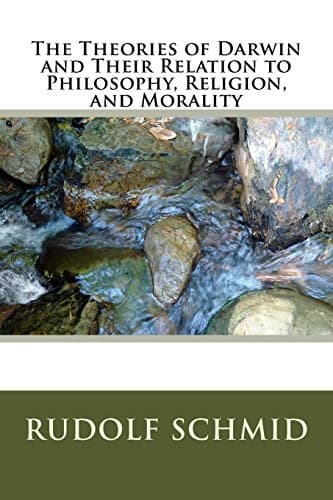
The Theories of Darwin and Their Relation to Philosophy, Religion, and MoralitySchmid, Rudolf
Religion
The Theories of Darwin and Their Relation to Philosophy, Religion, and Morality
Schmid, Rudolf
Evolution; Religion and science
It was demonstrated that in making man a mere product of nature, and
degrading him to a being that is nothing else but a more highly developed
animal, Darwinism takes from human personality its value, from the realms
of morality its dignity, and from its demands their autonomy. In making the
struggle for existence the principle of all development and, by extending
it to the development and social relations of man, at the same time the
human social principle, it puts in place of self-denial and love the
principle of egoism and boorishness and the right of the stronger, gives
full course to the unchaining of all animal passions, and coquettes with
all the emotions which, flattering the animal part of man, {231} aims at
the subversion of all that exists and at the destruction of the ideal
acquisitions of mankind. In tracing everything which constitutes the higher
position and dignity of man back to his own work, and permitting it to be
worked out of physical, spiritual, and ethical brutishness, in slow
development and effort, closely related to the animal kingdom, it fosters
and nourishes haughtiness in an intolerable way. And finally, in breaking
off and denying the dependence of man upon God, and leading to mechanical
determinism, it destroys the deepest and most effective motive to moral
action--the tracing of the moral law to the authority of the divine
Law-giver, and the consciousness of an individual moral responsibility.
It cannot be denied that many of the most zealous Darwinians gave too much
cause for such a conception and representation of the ethical consequences
of their system. In view of the fact that they applied the selection
principle, with its most radical consequences, to the origin and
development of mankind, and that they elevated the same to the ethical and
social principle of mankind and did not permit the acceptance of any new
and higher agencies in mankind except those already active in the animal
and the organic world, and that they gladly treated this selection
principle also in the social and ethical realm as a struggle for existence,
it was simply an entirely logical conclusion that the advocates of the
moral nobility of mankind reproached such a reproduced Darwinism with
degrading the moral dignity of man and with replacing love by egoism.
Besides, in view of the fact that they declared materialistic monism, even
the most naked atheism, the only conclusion of {232} Darwinism, and
extended their mechanistic explanation of the world to a determinism in the
highest degree mechanistic, and, carried to its utmost limit, to a denial
of human freedom, it was not to be wondered at that those who recognize in
theism the basis of all life worthy of man, and in the freedom of man one
of the most precious pearls in the crown of his human dignity and of his
creation in the image of God, complained of Darwinism's taking from
morality its strongest motive and from moral action its responsibility.
Public-domain text, read in full here on John Shaqi.
Reviews
Reviews
No reviews yet
Be the first to share your thoughts on this work.
Elsewhere in the archive
Join the Discussion
Join the discussion
Sign in to leave a comment or review.
Sign InorCreate an account