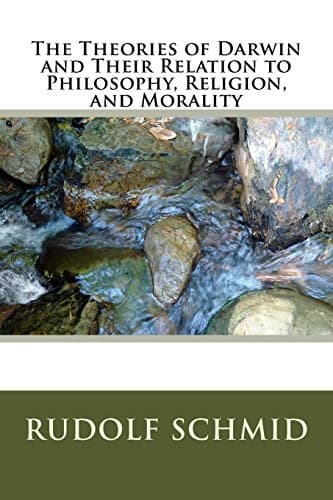
The Theories of Darwin and Their Relation to Philosophy, Religion, and MoralitySchmid, Rudolf
Religion
The Theories of Darwin and Their Relation to Philosophy, Religion, and Morality
Schmid, Rudolf
Evolution; Religion and science
It belongs to the _idea of God_, that we have to think of the sublimity of
God over time and space, of his eternity and omnipresence, in such a way
that God, in his being, life, and activity, does not stand _in_ time nor
within any limits or differences of space, but absolutely above time and
above all limits and differences of space; that he is _present_ in his
world everywhere and at any time. He who objects to this, can only do it
with weapons to which we have to oppose the objection which the adversaries
of the Christian idea of God so often raise against it--namely, the
objection of a rejectable _anthropomorphism_. In contesting the possibility
of the idea of an uninterrupted presence of a personal and living God in
the entire realm of the universe, the adversaries seem to permit themselves
to be daunted by the difficulty which is offered to man in controlling the
realms of his own activity. The greater such a realm, the more difficult
becomes a comprehensive survey, the more the human influence has to
restrict itself to the greater and more common and to neglect the little
and single. The more removed is the past which helps to constitute the
circumstances of the present, the greater is the human ignorance and
oblivion; the more removed is the future, the greater is the human
incapability of {350} influencing it decisively. Such measures ought to
disappear, even in their last traces, when we reflect on God and divine
activity. If once the idea is established for us of a living God, who is
always present in the world created by him, and in whose "sight a thousand
years are but as yesterday when it is past, and as a watch in the night,"
the final causal chain of causes and effects may be ever so long, and
stretching over this course of the world from its beginning to its end; the
single phenomena may be woven together of ever so many thousands and
thousands of millions of different causal chains: we nevertheless see above
them all the regulating hand of God from whom they all come, and who not
only surveys and controls their texture in all its threads, but who himself
arranged, wove, and made it. Such a view is not only more satisfactory to
the religious need of man, but it also seems to us more scientific, than a
view which traces everything back to a blind and dead cause, or even to no
ultimate cause at all, and thinks it has entirely removed the last veil, if
it pronounces the great word "causal law."
Public-domain text, read in full here on John Shaqi.
Reviews
Reviews
No reviews yet
Be the first to share your thoughts on this work.
Elsewhere in the archive
Join the Discussion
Join the discussion
Sign in to leave a comment or review.
Sign InorCreate an account