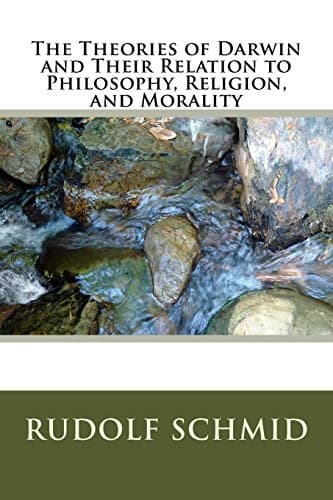
The Theories of Darwin and Their Relation to Philosophy, Religion, and MoralitySchmid, Rudolf
Religion
The Theories of Darwin and Their Relation to Philosophy, Religion, and Morality
Schmid, Rudolf
Evolution; Religion and science
In the first place, we help to establish the full recognition of that
direct religious consciousness and sensation which is not only
characteristic of the pious men of Scripture, but which yet characterizes
all genuine religiousness; and this consists in the fact that the religious
man sees {364} _miracles of God in all that turns his attention to God's
government_,--in the sea of stars, in rock and bush, in sunshine and storm,
in flower and worm, just as certainly as in the guidance of his own life
and in the facts and processes of the history of salvation and of the
kingdom of the Lord. In this idea of miracles, the essential thing is not
that the phenomena and processes are inconceivable to him--although
certainly in all that comes into appearance there is still an
incomprehensible and uncomprehended remainder. For a form of nature,
_e.g._, which turns his attention to a creator, is of course a miracle,
even if he is able to look upon it with none other eye than that of the
unlearned: but it even then remains a miracle,--nay, it is increased to a
still greater miracle, if he has learned to contemplate and investigate it
with all the auxiliary means of science. A hearing of his prayers remains a
miracle, whether or not he is able to perceive the natural connection of
the process in which he sees his prayers answered, or even to trace it back
to the remotest times which preceded his prayers. The events and facts of
the history of salvation remain miracles to him, whether the history of
nature and the world offers to him auxiliary means of explaining them or
not. The pious man, therefore, does not find the essential characteristic
of miracles in their relative inconceivableness, but in the fact that they
refer him to a living God who stands above this process, whether perceived
or unperceived in its relative causal connection, and unites it with the
course of things in order to reach his ends and to manifest himself to man.
Now, in our attempt at a scientific reproduction of the idea of miracles,
if we return to that Biblical conception, we see no longer in this just
{365} mentioned religious conception of miracles a pious sophistry which
avoids the difficulty of the idea, or a child-like _naivete_ worthy of
being partly envied and partly pitied, which does not at all see the
difficulties and remains on the child-stage of Biblical conceptions; but we
only perceive in it a confirmation and fulfilment of that profound and
beneficent word of our Lord: "Verily I say unto you, Whosoever shall not
receive the kingdom of God as a little child, he shall not enter therein."
Of course, piety as well as science makes _distinctions_ among miracles.
The former separates the _mere products and processes of nature_ which,
through what is explicable as well as what is inexplicable in their
qualities and processes, point to an almighty and all-wise Creator, and
thereby become miracles to the religious view of the world, from the
Public-domain text, read in full here on John Shaqi.
Reviews
Reviews
No reviews yet
Be the first to share your thoughts on this work.
Elsewhere in the archive
Join the Discussion
Join the discussion
Sign in to leave a comment or review.
Sign InorCreate an account