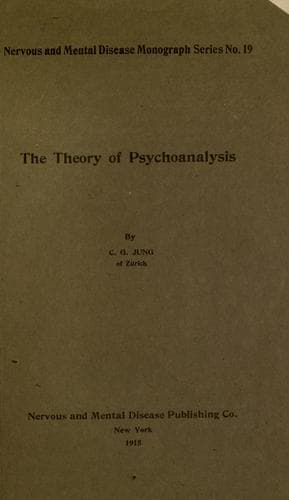
The Theory of PsychoanalysisJung, C. G. (Carl Gustav)
Science
The Theory of Psychoanalysis
Jung, C. G. (Carl Gustav)
Neuroses; Psychoanalysis; Psychology, Pathological; Sex
These sexual tendencies have caused the fear of the father. Still, we
must not forget that she had this dream in her fifth year. At that time
these sins had not been committed. Hence we must regard this affair with
the other girls as a reason for her present fear of her father; but that
does not explain the earlier fear. But still, we may expect it was
something of a similar nature, some unconscious sexual wish,
corresponding to the psychology of the forbidden action previously
mentioned. The moral value and character of this wish is even more
unconscious with the child than with adults. To understand what had made
an impression on the child, we have to ask what happened in her fifth
year. Her youngest brother was born at that time. Even then her father
had made her nervous. The associations previously referred to give us an
undoubted connection between her sexual inclinations and her anxiety.
The sexual problem, which nature connects with positive feelings of
delight, is in the dream brought to the surface in the form of fear,
apparently on account of the bad father, who represents moral education.
This dream illustrates the first impressive appearance of the sexual
problem, obviously suggested by the recent birth of the little brother,
just such an occasion when experience teaches us that these questions
become vital.
Just because the sexual problem is closely connected with certain
pleasurable physical sensations, which education tries to reduce and
break off, it can apparently only manifest itself hidden under the cloak
of moral anxiety as to sin. This explanation certainly seems rather
plausible, but it is superficial, it is insufficient. It attributes the
difficulties to the moral education, on the unproved assumption that
education can cause such a neurosis. We hereby leave out of
consideration the fact that there are people who have become neurotic
and suffer from morbid fears without having had a trace of moral
education. Moreover, the moral law is not merely an evil, which has to
be resisted, but a necessity, born out of the utmost needs of humanity.
The moral law is only an outward manifestation of the innate human
impulse to dominate and tame oneself. The origin of the impulse towards
domestication or civilization is lost in the unfathomable depths of the
history of evolution, and can never be conceived as the consequence of
certain laws imposed from without. Man himself, obeying his instincts,
created laws. Therefore, we shall never understand the reasons for the
repression of sexuality in the child if we only take into account the
moral influences of education. The main reasons are to be found much
deeper, in human nature itself, in its perhaps tragic contradiction
between civilization and nature, or between individual consciousness and
the general conscience of the community. I cannot enter into these
questions now; in my other work, I have tried to do so. Naturally, it
Public-domain text, read in full here on John Shaqi.
Reviews
Reviews
No reviews yet
Be the first to share your thoughts on this work.
Elsewhere in the archive
Join the Discussion
Join the discussion
Sign in to leave a comment or review.
Sign InorCreate an account