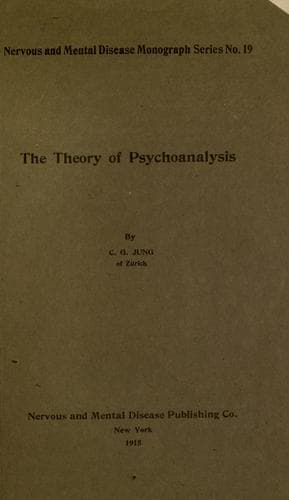
The Theory of PsychoanalysisJung, C. G. (Carl Gustav)
Science
The Theory of Psychoanalysis
Jung, C. G. (Carl Gustav)
Neuroses; Psychoanalysis; Psychology, Pathological; Sex
I can thus roughly describe the picture I got at finally. As a child the
patient was thoroughly boyish, loved only turbulent games for boys,
laughed at her own sex, and flung aside all feminine ways and
occupations. After puberty, the time when the sex-question should have
come nearer to her, she began to shun all society; she hated and
despised, as it were, everything which could remind her even remotely of
the biological destination of mankind, and lived in a world of
phantasies which had nothing in common with the rude reality. So she
escaped, up to her twenty-fourth year, all the little adventures, hopes
and expectations which ordinarily move a woman of this age. (In this
respect women are very often remarkably insincere towards themselves and
towards the physician.) But she became acquainted with two men who were
destined to destroy the thorny hedge which had grown all around her. Mr.
A. was the husband of her best friend at the time; Mr. B. was the
bachelor-friend of this family. Both were to her taste. It seemed to her
pretty soon that Mr. B. was much more sympathetic to her, and from this
resulted a more intimate relationship between herself and him, and the
possibility of an engagement was discussed. Through her relations with
Mr. B., and through her friend, she met Mr. A. frequently. In an
inexplicable way his presence very often excited her and made her
nervous. Just at this time our friend went to a big party. All her
friends were there. She became lost in thought, and played as in a dream
with her ring, which suddenly slipped from her hand and rolled under the
table. Both men tried to find it, and Mr. B. managed to get it. With an
expressive smile he put the ring back on her finger and said: “You know
what this means?” At that moment a strange and irresistible feeling came
over her, she tore the ring from her finger and threw it out of the open
window. Evidently a painful moment ensued, and she soon left the
company, feeling deeply depressed. A short time later she found herself,
for her holidays, accidentally in the same health-resort where Mr. A.
and his wife were staying. Mrs. A. now became more and more nervous,
and, as she felt ill, had to stay frequently at home. The patient often
went out with Mr. A. alone. One day they were out in a small boat. She
was boisterously merry, and suddenly fell overboard. Mr. A. saved her
with great difficulty, and lifted her, half unconscious, into the boat.
He then kissed her. With this romantic event the bonds were woven fast.
To defend herself, our patient tried energetically to get herself
engaged to Mr. B., and to imagine that she loved him. Of course this
queer play did not escape the sharp eye of feminine jealousy. Mrs. A.,
her friend, felt the secret, was worried by it, and her nervousness grew
proportionately. It became more and more necessary for her to go to a
foreign health-resort. The farewell-party was a dangerous opportunity.
Public-domain text, read in full here on John Shaqi.
Reviews
Reviews
No reviews yet
Be the first to share your thoughts on this work.
Elsewhere in the archive
Join the Discussion
Join the discussion
Sign in to leave a comment or review.
Sign InorCreate an account