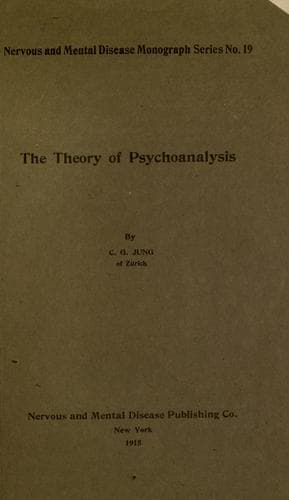
The Theory of PsychoanalysisJung, C. G. (Carl Gustav)
Science
The Theory of Psychoanalysis
Jung, C. G. (Carl Gustav)
Neuroses; Psychoanalysis; Psychology, Pathological; Sex
The patient knew that her friend and rival was going off the same
evening, so Mr. A. would be alone. Certainly she did not see this
opportunity clearly, as women have the notable capacity “to think”
purely emotionally, and not intellectually. For this reason, it seems to
them as if they never thought about certain matters at all, but as a
matter of fact she had a queer feeling all the evening. She felt
extremely nervous, and when Mrs. A. had been accompanied to the station
and had gone, the hysterical attack occurred on her way back. I asked
her of what she had been thinking, or what she felt at the actual moment
when the trotting horses came along. Her answer was, she had only a
frightful feeling, the feeling that something dreadful was very near to
her, which she could not escape. As you know, the consequence was that
the exhausted patient was brought back into the house of the host, Mr.
A. A simple human mind would understand the situation without
difficulty. An uninitiated person would say: “Well, that is clear
enough, she only intended to return by one way or another to Mr. A.’s
house,” but the psychologist would reproach this layman for his
incorrect way of expressing himself, and would tell him that the patient
was not conscious of the motives of her behavior, and that it was,
therefore, not permissible to speak of the patient’s intention to return
to Mr. A.’s house.
There are, of course, learned psychologists who are capable of
furnishing many theoretical reasons for disputing the meaning of this
behavior. They base their reasons on the dogma of the identity of
consciousness and psyche. The psychology inaugurated by Freud recognized
long ago that it is impossible to estimate psychological actions as to
their final meaning by conscious motives, but that the objective
standard of their psychological results has to be applied for their
right evaluation. Now-a-days it cannot be contested any longer that
there are unconscious tendencies too, which have a great influence on
our modes of reaction, and on the effects to which these in turn give
rise. What happened in Mr. A.’s house bears out this observation; our
patient made a sentimental scene, and Mr. A. was induced to answer it
with a declaration of love. Looked at in the light of this last event,
the whole previous history seems to be very ingeniously directed towards
just this end, but throughout the conscience of the patient struggled
consciously against it. Our theoretical profit from this story is the
clear perception that an unconscious purpose or tendency has brought on
to the stage the scene of the fright from the horses, utilizing thus
very possibly that infantile reminiscence, where the shying horses
galloped towards the catastrophe. Reviewing the whole material, the
scene with the horses—the starting point of the illness—seems now to be
the keystone of a planned edifice. The fright, and the apparent
traumatic effect of the event in childhood, are only brought on the
Public-domain text, read in full here on John Shaqi.
Reviews
Reviews
No reviews yet
Be the first to share your thoughts on this work.
Elsewhere in the archive
Join the Discussion
Join the discussion
Sign in to leave a comment or review.
Sign InorCreate an account