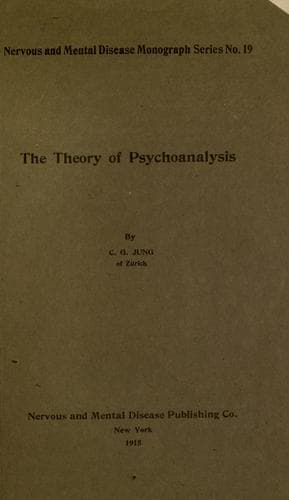
The Theory of PsychoanalysisJung, C. G. (Carl Gustav)
Science
The Theory of Psychoanalysis
Jung, C. G. (Carl Gustav)
Neuroses; Psychoanalysis; Psychology, Pathological; Sex
stage in the peculiar way characteristic of hysteria. But what is thus
put on the stage has become almost a reality. We know from hundreds of
experiences that certain hysterical pains are only put on the stage in
order to reap certain advantages from the sufferer’s surroundings. The
patients not only believe that they suffer, but their sufferings are,
from a psychological standpoint, as real as those due to organic causes;
nevertheless, they are but stage-effects.
The Regression of Libido
This utilization of reminiscences to put on the stage any illness, or an
apparent etiology, is called a _regression of the libido_. The libido
goes back to reminiscences, and makes them actual, so that an apparent
etiology is produced. In this case, by the old theory, the fright from
the horses would seem to be based on a former shock. The resemblance
between the two scenes is unmistakable, and in both cases the patient’s
fright is absolutely real. At any rate, we have no reason to doubt her
assertions in this respect, as they are in full harmony with all other
experiences. The nervous asthma, the hysterical anxiety, the psychogenic
depressions and exaltations, the pains, the convulsions—they are all
very real, and that physician who has himself suffered from a
psychogenic symptom knows that it feels absolutely real. Regressively
re-lived reminiscences, even if they were but phantasies, are as real as
remembrances of events that have once been real.
As the term “regression of libido” shows, we understand by this
retrograde mode of application of the libido, a retreat of the libido to
former stages. In our example, we are able to recognize clearly the way
the process of regression is carried on. At that farewell party, which
proved a good opportunity to be alone with the host, the patient shrank
from the idea of turning this opportunity to her advantage, and yet was
overpowered by her desires, which she had never consciously realized up
to that moment. The libido was not used consciously for that definite
purpose, nor was this purpose ever acknowledged. The libido had to carry
it out through the unconscious, and through the pretext of the fright
caused by an apparently terrible danger. Her feeling at the moment when
the horses approached illustrates our formula most clearly; she felt as
if something inevitable had now to happen.
Public-domain text, read in full here on John Shaqi.
Reviews
Reviews
No reviews yet
Be the first to share your thoughts on this work.
Elsewhere in the archive
Join the Discussion
Join the discussion
Sign in to leave a comment or review.
Sign InorCreate an account