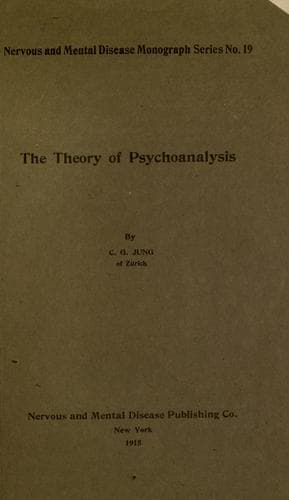
The Theory of PsychoanalysisJung, C. G. (Carl Gustav)
Science
The Theory of Psychoanalysis
Jung, C. G. (Carl Gustav)
Neuroses; Psychoanalysis; Psychology, Pathological; Sex
The so-called _amnesia of childhood_, which plays an important part in
the “Three Contributions,” is a similar illegitimate retrograde
application from pathology. Amnesia is a pathological condition,
consisting in the repression of certain contents of the conscious. This
condition cannot possibly be the same as the antegrade amnesia of
children, which consists in an incapacity for intentional reproduction,
a condition we find also among savages. This incapacity for reproduction
dates from birth, and can be understood on obvious anatomical and
biological grounds. It would be a strange hypothesis were we willing to
regard this totally different quality of early infantile consciousness
as one to be attributed to repression, in analogy with the condition in
neurosis. The amnesia of neurosis is punched out, as it were, from the
continuity of memory, but the remembrances of earlier childhood exist in
separate islands in the continuity of the non-memory. This condition is
the opposite in every sense of the condition of neurosis, so that the
expression “amnesia,” generally used for this condition, is incorrect.
The “amnesia of childhood” is a conclusion _a posteriori_ from the
psychology of neurosis, just as is the “polymorphic perverse”
disposition of the child.
The Latent Sexual Period Criticized
This error in the theoretical conception is shown clearly in the
so-called _latent sexual period of childhood_. Freud has remarked that
the early infantile so-called sexual manifestations, which I now call
the phenomena of the pre-sexual stage, vanish after a while, and only
reappear much later. Everything that Freud has termed the “suckling’s
masturbation,” that is to say, all those sexual-like actions of which we
spoke before, are said to return later as real onanism. Such a process
of development would be biologically unique. In conformity with this
theory one would have to say, for instance, that when a plant forms a
bud, from which a blossom begins to unfold, the blossom is taken back
again before it is fully developed, and is again hidden within the bud,
to reappear later on in the same form. This impossible supposition is a
consequence of the assertion that the early infantile activities of the
pre-sexual stage are sexual phenomena, and that those manifestations,
which resemble masturbation, are genuinely acts of masturbation. In this
way Freud had to assert that there is a disappearance of sexuality, or,
as he calls it, a _latent sexual period_. What he calls a disappearance
of sexuality is nothing but the _real beginning of sexuality_,
everything preceding was but the fore-stage to which no real sexual
character can be imputed. In this way, the impossible phenomenon of the
latent period is very simply explained. This theory of the latent sexual
period is a striking instance of the incorrectness of the conception of
the early infantile sexuality. But there has been no error of
observation.
Public-domain text, read in full here on John Shaqi.
Reviews
Reviews
No reviews yet
Be the first to share your thoughts on this work.
Elsewhere in the archive
Join the Discussion
Join the discussion
Sign in to leave a comment or review.
Sign InorCreate an account