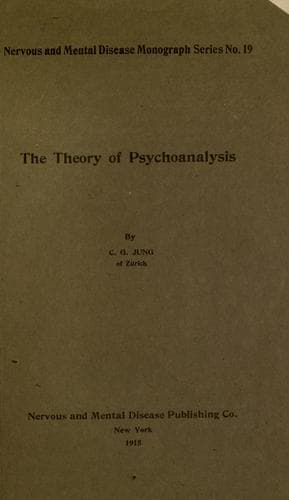
The Theory of PsychoanalysisJung, C. G. (Carl Gustav)
Science
The Theory of Psychoanalysis
Jung, C. G. (Carl Gustav)
Neuroses; Psychoanalysis; Psychology, Pathological; Sex
On the contrary, the hypothesis of the latent sexual period
proves how exactly Freud noticed the apparent recommencement of
sexuality. The error lies in the conception. As we saw before, the first
mistake consists in a somewhat old-fashioned conception of the
multiplicity of instincts. If we accept the idea of two or more
instincts existing side by side, we must naturally conclude that, if one
instinct has not yet become manifest, it is present in nuce in
accordance with the theory of pre-formation. In the physical sphere we
should perhaps have to say that, when a piece of iron passes from the
condition of heat to the condition of light, the light was already
existent in nuce (latent) in the heat. Such assumptions are arbitrary
projections of human ideas into transcendental regions, contravening the
prescription of the theory of cognition.
We have thus no right to speak of a sexual instinct existing in nuce, as
we then give an arbitrary explanation of phenomena which can be
explained otherwise, and in a more adequate manner. We can speak of the
manifestations of a nutrition instinct, of the manifestations of a
sexual instinct, etc., but we have only the right to do so when the
function has quite clearly reached the surface. We only speak of light
when the iron is visibly luminous, but not when the iron is merely hot.
Freud, as an observer, sees clearly that the sexuality of neurotic
people is not entirely comparable with infantile sexuality, for there is
a great difference, for instance, between the uncleanliness of a child
of two years old and the uncleanliness of a katatonic patient of forty.
The former is a psychological and normal phenomenon; the latter is
extraordinarily pathological. Freud inserted a short passage in his
“Three Contributions” saying that the infantile form of neurotic
sexuality is either wholly, or at any rate partly, due to a regression.
That is, even in those cases where we might say, these are still the
same by-paths, we find that the function of the by-paths is still
increased by regression. Freud thus recognizes that the infantile
sexuality of neurotic people is _for the greater part_ a regressive
phenomenon. That this must be so is also shown through the further
insight obtained from the investigations of recent years, that the
observations concerning the psychology of the childhood of neurotic
people hold equally good for normal people. At any rate we can say that
the history of the development of infantile sexuality in persons with
neurosis differs but by a hair’s breadth from that of normal beings who
have escaped the attention of the expert appraiser. Striking differences
are exceptional.
Further Remarks on the Etiology of Neurosis
Public-domain text, read in full here on John Shaqi.
Reviews
Reviews
No reviews yet
Be the first to share your thoughts on this work.
Elsewhere in the archive
Join the Discussion
Join the discussion
Sign in to leave a comment or review.
Sign InorCreate an account