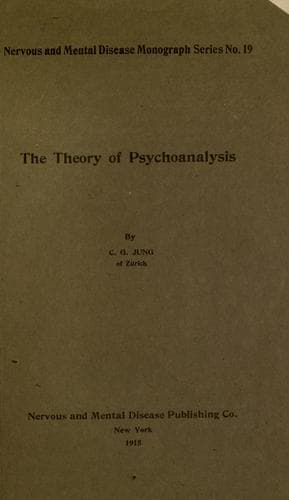
The Theory of PsychoanalysisJung, C. G. (Carl Gustav)
Science
The Theory of Psychoanalysis
Jung, C. G. (Carl Gustav)
Neuroses; Psychoanalysis; Psychology, Pathological; Sex
This surplus of sensitiveness is found very often as an enrichment of a
personality contributing even more to the charm of the character than to
its detriment. But in difficult and uncommon situations the advantage
very often turns into a disadvantage, as the inopportunely excited
emotion renders calm consideration impossible. Nothing could be more
incorrect than to consider this sensitiveness as eo ipso a morbid
constituent of a character. If it really were so, we should have to
regard at least one third of humanity as pathological. Only if the
consequences of this sensitiveness are destructive to the individual
have we a right to consider this quality as abnormal.
_Primary Sensitiveness and Regression._—We come to this difficulty when
we crudely oppose the two conceptions as to the significance of the
previous psychological history as we have done here; in reality, the two
are not mutually exclusive. A certain innate sensitiveness leads to a
special psychological history, to special reactions to infantile events,
which are not without their own influence on the development of the
childish conception of life. Events bound up with powerful impressions
can never pass without leaving some trace on sensitive people. Some of
these often remain effective throughout life, and such events can exert
an apparently determining influence on the whole mental development.
Dirty and disillusional experiences in the domain of sexuality are
specially apt to frighten a sensitive person for years and years. Under
these conditions, the mere thought of sexuality raises the greatest
resistances. As the creation of the shock-theory proved, we are too much
inclined, in consequence of our knowledge of such cases, to attribute
the emotional development of a person more or less to accidents. The
earlier shock-theory went too far in this respect. We must never forget
that _the world is, in the first place, a subjective phenomenon. The
impressions we receive from these happenings are also our own doing._ It
is not the case that the impressions are forced on us unconditionally,
but our disposition gives the value to the impressions. A man with
stored-up libido will as a rule have quite different impressions, much
more vivid impressions, than one who organizes his libido into a rich
activity. Such a sensitive person will have a more profound impression
from certain events which might harmlessly pass over a less sensitive
subject. Therefore, in conjunction with the accidental impression, we
have to consider seriously the subjective conditions. Our former
considerations, and the observation of the concrete case especially,
show us that the important subjective condition is the regression. It is
shown by experience in practice, that the effect of regression is so
enormous, so important and so impressive, that we might perhaps be
inclined to attribute the effect of accidental events to the mechanism
of regression only. Without any doubt, there are cases in which
Public-domain text, read in full here on John Shaqi.
Reviews
Reviews
No reviews yet
Be the first to share your thoughts on this work.
Elsewhere in the archive
Join the Discussion
Join the discussion
Sign in to leave a comment or review.
Sign InorCreate an account