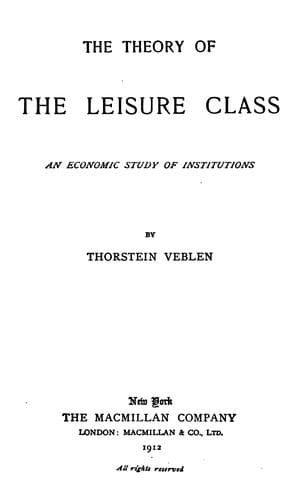
In point of derivation and early development, learning is somewhat
closely related to the devotional function of the community,
particularly to the body of observances in which the service rendered
the supernatural leisure class expresses itself. The service by which it
is sought to conciliate supernatural agencies in the primitive cults is
not an industrially profitable employment of the community's time and
effort. It is, therefore, in great part, to be classed as a vicarious
leisure performed for the supernatural powers with whom negotiations
are carried on and whose good-will the service and the professions of
subservience are conceived to procure. In great part, the early learning
consisted in an acquisition of knowledge and facility in the service of
a supernatural agent. It was therefore closely analogous in character to
the training required for the domestic service of a temporal master. To
a great extent, the knowledge acquired under the priestly teachers of
the primitive community was knowledge of ritual and ceremonial; that
is to say, a knowledge of the most proper, most effective, or most
acceptable manner of approaching and of serving the preternatural
agents. What was learned was how to make oneself indispensable to these
powers, and so to put oneself in a position to ask, or even to require,
their intercession in the course of events or their abstention from
interference in any given enterprise. Propitiation was the end, and this
end was sought, in great part, by acquiring facility in subservience.
It appears to have been only gradually that other elements than those
of efficient service of the master found their way into the stock of
priestly or shamanistic instruction.
The priestly servitor of the inscrutable powers that move in the
external world came to stand in the position of a mediator between these
powers and the common run of unrestricted humanity; for he was possessed
of a knowledge of the supernatural etiquette which would admit him into
the presence. And as commonly happens with mediators between the vulgar
and their masters, whether the masters be natural or preternatural, he
found it expedient to have the means at hand tangibly to impress upon
the vulgar the fact that these inscrutable powers would do what he might
ask of them. Hence, presently, a knowledge of certain natural processes
which could be turned to account for spectacular effect, together with
some sleight of hand, came to be an integral part of priestly lore.
Knowledge of this kind passes for knowledge of the "unknowable", and
it owes its serviceability for the sacerdotal purpose to its recondite
character. It appears to have been from this source that learning, as an
institution, arose, and its differentiation from this its parent stock
of magic ritual and shamanistic fraud has been slow and tedious, and is
scarcely yet complete even in the most advanced of the higher seminaries
of learning.
Public-domain text, read in full here on John Shaqi.
Reviews
Reviews
No reviews yet
Be the first to share your thoughts on this work.
Elsewhere in the archive
Join the Discussion
Join the discussion
Sign in to leave a comment or review.
Sign InorCreate an account