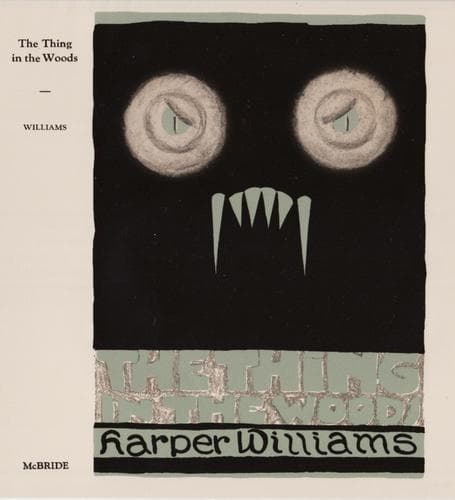
I stared at him. I suppose I looked stupid. I felt it. It was as
though some spectre, strange, ghastly, altogether of another world,
had risen up suddenly there before us in these quiet Pennsylvania
woods.
"A mania--subject imagines himself some beast, resulting in actual
physical transformations--exhibits depraved appetites--frequently
homicidal..." I recalled haltingly the words of an old treatise.
"They did more than believe they were animals," said Herrick dryly.
"They seem to have succeeded in impressing their belief pretty
strongly upon their neighbours and relatives. Did you ever dig into
old records of that sort, Austin? The were-wolf stories of the
Middle Ages? They're rather grim reading."
I was silent.
"Remember our facts," he went on. "Menning's mother came from
Westphalia, one of the parts of Europe where the belief in
lycanthropy is most widely spread and where its existence is still
credited among the peasants of today. Lycanthropy was believed to be
a hereditary taint, as transmissible as insanity, which may lie
dormant through one or more generations, so much so that at one time
the relatives of an accused man or woman were all held suspect.
There seems to have been more or less of a mystery about the Mennings
altogether, chiefly on account of the mother's character, and most
particularly in regard to Jakey. Remember also what Lennox said
about the strong persistence of type in both sons, although of
different paternity. We have Lennox's assertion that there was
something peculiar, 'animal', about Jakey, which certainly impressed
him, but which he seemed rather at a loss to describe. Then there is
that unexplained incident when Jakey was with the circus. Whatever
it was, it was something that gave such a shock to the
proprietor--who, remember, had originally conceived the idea of the
wild-man stunt himself, so wasn't likely to have been taken in by
acting--that he sacrificed his best drawing card then and there
sooner than have Jakey remain another night with the show. All the
brother would say was that he 'guessed Jakey acted too well,' which
in itself is fairly significant.
"That Aaron knew, or suspected, certain facts about his brother,
there is no doubt. Why else should he so obstinately oppose any
medical examination, and particularly the idea of Jakey being removed
even temporarily from their control? Why did he make the very
singular statement that Jakey was 'all right in the daytime,' and
that _at night they shut him up_?"
"And the bullet?" I asked.
"Do you remember that Aaron promised if it became necessary he would
take steps? What those steps were he did not say, but I believe
myself that this silver bullet answers the question. Remember the
horror in which lycanthropy was held, the revulsion it excited, and
think whether he would not have resorted to the gravest measures
sooner than have the whole concealed story come to light.
Public-domain text, read in full here on John Shaqi.
Reviews
Reviews
No reviews yet
Be the first to share your thoughts on this work.
Elsewhere in the archive
Join the Discussion
Join the discussion
Sign in to leave a comment or review.
Sign InorCreate an account