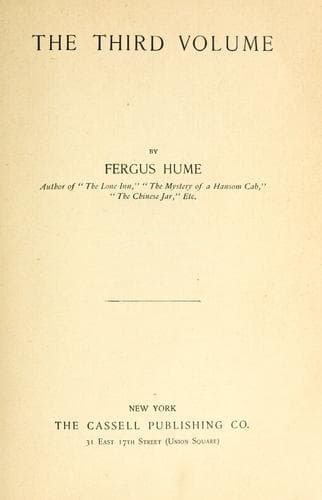
Detective and mystery stories; England -- Social life and customs -- 19th century -- Fiction; Murder -- Investigation -- Fiction
"The rest you know. My wife was accused and tried for my murder,
as Jeringham's corpse was so disfigured that it was thought to
be mine. I have mentioned the strong resemblance between us, and
this helped the deception. I was compelled to keep in hiding as
Jeringham, but I declare, had the case gone against my wife, I
should have come forward and told all. As it was I went abroad,
aided by Hilliston, who acted as my friend all through. He
looked after my unhappy wife till she died in London; he took
charge of you and brought you up like a son. He also secured me
sufficient of my own property to live quietly, so I came to
Thorston under the name of Paynton, and here I have lived ever
since. I thought to die in peace, but you, Claude, have reopened
the case. I tell you this to show you the futility of trying to
find the real murderer. I do not know who killed Jeringham, nor
do I think you will ever find out. If, after reading this, you
still consider me your father, come at once to a most unhappy
man. Be just, be lenient, my son, and forgive your unhappy
father,
"GEORGE LARCHER."
CHAPTER XXXVIII.
A NEW ASPECT OF THINGS.
TAIT folded over the last sheet of this long letter with a sigh.
Although he was pleased for Claude's sake that George Larcher was still
in the land of the living, yet he was distinctly disappointed that no
communication had been made likely to elucidate the mystery. Yet the
result of this confession was an entire displacement of the point whence
it was necessary to survey the case. The motives which had caused the
supposed death of Larcher would not suffice to explain the death of
Jeringham. The case had assumed a new aspect, but nevertheless it was as
complex and inexplicable as ever. Tait thought of all this with
inconceivable rapidity, but did not give utterance to his opinion in the
presence of his friend.
"The letter is wonderful, so far," was his sole remark, "but it is a
great pity that it ends so abruptly. I suppose your father will
personally relate all other details, Claude, when you see him again."
The young man assumed a sitting position, and deliberately finished his
wine before replying to this remark. He looked anxious and disturbed,
and, now that he had recovered from the overwhelming surprise at finding
his father alive, seemed less delighted than he should have been. A
miracle had been wrought in his behalf; the dead had been restored to
life; but he was by no means gratified by the occurrence.
"I don't know whether I shall see my father again," he said shortly.
"But, my dear friend----"
Public-domain text, read in full here on John Shaqi.
Reviews
Reviews
No reviews yet
Be the first to share your thoughts on this work.
Elsewhere in the archive
Join the Discussion
Join the discussion
Sign in to leave a comment or review.
Sign InorCreate an account