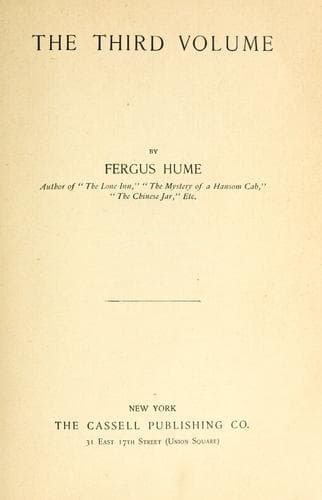
Detective and mystery stories; England -- Social life and customs -- 19th century -- Fiction; Murder -- Investigation -- Fiction
That Claude should call Mr. Paynton "father" is of course only regarded
as natural by the village. Has he not married Jenny, and does he not
stand in the relation of a son to the old man? Thorston gossips think he
is a most perfect son-in-law, and never guess that any nearer
relationship exists between them.
Of course Jenny and Claude were married as speedily as possible, and I
do not know a happier couple. Mrs. Larcher has quite converted me with
regard to the fair sex, and plumes herself on her victory. She has the
audacity to say that she will yet succeed in getting me married, but I
think that is beyond her powers. Mr. Linton married them, and they spent
their honeymoon at the Manor House, which I lent them for the occasion.
Indeed, while at Thorston they invariably live with me, and I should be
offended did they take up their quarters anywhere else. Not that they
have any desire to do so, for Rose Cottage is rather small, and,
besides, the Manor is within easy distance of it, so that Jenny can see
her father--or, rather, her father-in-law--as often as she chooses.
Claude still goes to different parts of the world to build bridges and
construct railways. Sometimes his wife goes with him, but she does not
like to be so long away from Thorston. Paynton is now an old man, and
cannot live long, so Mrs. Larcher wishes to be near him as much as
possible. Besides, the cares of the nursery take up her attention, so I
think that in a few months Claude will settle down to business in
London, and make his home at Thorston, as he always intended to do.
There is a pleasant little place not far from the Manor which I have
been commissioned to buy for him, so I really think that next year
Claude and Jenny will take up their residence among us.
The only person who disapproved of the marriage was Frank Linton, who
accused Jenny of jilting him. This was utter nonsense, as she never had
any intention of becoming his wife. However, the author considers
himself badly treated, and has taken up his quarters in London, where he
writes books, and poses in Chelsea circles. But I do not think he will
ever write so excellent a book as "A Whim of Fate," perhaps because Mrs.
Claude Larcher refuses to tell him any more plots. She has a good reason
for so doing, as the troubles which arose out of her finding the murder
papers in the garret of Rose Cottage have startled her in no small
degree. Still, as I tell her, she must look on such troubles as a
blessing in disguise, for, after all, they led to her marriage and
present happiness. But Mrs. Claude does not see the matter in so amiable
a light.
Public-domain text, read in full here on John Shaqi.
Reviews
Reviews
No reviews yet
Be the first to share your thoughts on this work.
Elsewhere in the archive
Join the Discussion
Join the discussion
Sign in to leave a comment or review.
Sign InorCreate an account