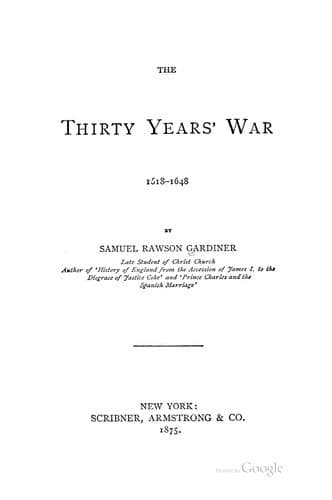
The Thirty Years' War, 1618-1648Gardiner, Samuel Rawson
History
The Thirty Years' War, 1618-1648
Gardiner, Samuel Rawson
Thirty Years' War, 1618-1648
The first attempt of Gustavus to win over a prince of the Empire to his
side was made before Stettin, the capital of the Duke of Pomerania. He
insisted on a personal interview with the aged Boguslav, the last of the
old Wendish line. Boguslav had ever been on good terms with the Emperor.
He had helped Wallenstein at Stralsund. But his deputies had pleaded in
vain at Ratisbon for his right to retain the bishopric of Camin and for
some amelioration of the misery of his subjects. He now pleaded in
person with Gustavus to be allowed to remain neutral. Gustavus, like
Tilly in 1623, would hear nothing of neutrality. The old man could hold
out no longer. "Be it as you wish, in God's name," he said. He begged
the king to be a father to him. "Nay," replied Gustavus, "I would rather
be your son." The inheritance of the childless man would make an
excellent bulwark for the defence of the Baltic.
[Sidenote: § 3. The Elector of Brandenburg prefers neutrality.]
For some time longer Gustavus was busy in securing a basis of operations
along the coast by clearing Pomerania and Mecklenburg of imperialist
garrisons. But, as yet, the northern princes were unwilling to
support him. In vain Gustavus reasoned with the ambassador of his
brother-in-law, the Elector of Brandenburg, who had come to announce his
master's neutrality. "It is time," he said, "for his highness to open
his eyes, and to rouse himself from his ease, that his highness may no
longer be in his own land a lieutenant of the Emperor, nay, rather of
the Emperor's servant. He who makes a sheep of himself is eaten by the
wolf. His highness must be my friend or enemy, when I come to his
frontier. He must be hot or cold. No third course will be allowed, be
you sure of that." The words were thrown away for the present. There may
have been something of mere cowardice in the Elector's resistance to the
overtures made to him. Frederick had failed, and Christian had failed,
and why not Gustavus? But there was something, too, of the old German
feeling remaining, of unwillingness to join with the foreigner against
the Empire. "To do so," said the Brandenburg ambassador, "would be both
dishonourable and disloyal."
[Sidenote: § 4. Negotiations between Sweden and France.]
Gustavus had but to wait till Ferdinand's repeated blunders made loyalty
impossible even with the much-enduring George William. Fortunately for
Gustavus, he was now in a position in which he was able to wait a
little. An attempt had been made in France to overthrow Richelieu, in
which the queen mother, Mary of Medici, had taken a leading part.
Richelieu, she warned her son, was leading him to slight the interests
of the Church. But Lewis was unconvinced, and Mary of Medici found that
all political authority was in Richelieu's hands.
[Sidenote: 1631.
§ 5. The Treaty of Bärwalde.]
Public-domain text, read in full here on John Shaqi.
Reviews
Reviews
No reviews yet
Be the first to share your thoughts on this work.
Elsewhere in the archive
Join the Discussion
Join the discussion
Sign in to leave a comment or review.
Sign InorCreate an account