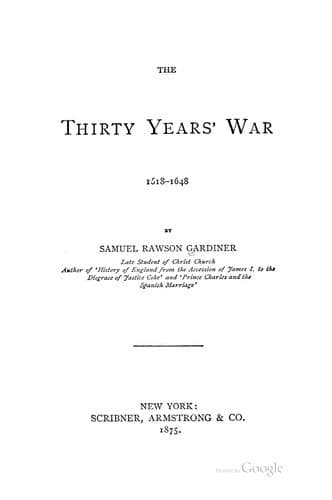
The Thirty Years' War, 1618-1648Gardiner, Samuel Rawson
History
The Thirty Years' War, 1618-1648
Gardiner, Samuel Rawson
Thirty Years' War, 1618-1648
Even now Ferdinand was preparing his answer to the last appeal of the
faithful Protestant estates. The Edict of Restitution he would maintain
to the uttermost. Of the armament of the princes he spoke in terms of
contemptuous arrogance. Let John George and his companions in ill-doing
dismiss their soldiers, and not presume to dictate terms by force to the
head of the Empire. Ferdinand had declared the law as it was, and by the
law he meant to abide.
CHAPTER VIII.
THE VICTORIES OF GUSTAVUS ADOLPHUS.
SECTION I.--_Alliance between the Swedes and the Saxons._
[Sidenote: 1631.
§ 1. The camp of Werben.]
A great fear fell upon the minds of all Protestant men. The cities of
the south, Augsburg and Nüremberg, which had begun to protest against
the execution of the edict, fell back into silence. In the north,
Gustavus, using terror to counteract terror, planted his cannon before
the walls of Berlin, and wrung from his reluctant brother-in-law the
renunciation of his neutrality. But such friendship could last no longer
than the force which imposed it, and John George could not be won so
easily. William of Hesse Cassel was the first of the German princes to
come voluntarily into the camp of Gustavus. Bernhard of Saxe-Weimar came
too, young as he was, full of military experience, and full too of
memories of his forefathers, the heroes of that old Saxon line which had
forfeited the Saxon Electorate for the sake of the Gospel. But neither
William nor Bernhard could bring much more than their own swords.
Gustavus dared not take the offensive. Throwing up an entrenched camp at
Werben, where the Havel joins the Elbe, he waited for Tilly, and
repulsed an attack made upon him. But what was such a victory worth?
Hardships and disease were thinning his ranks, and unless aid came, the
end would be very near.
[Sidenote: § 2. Tilly reinforced.]
The aid which he needed was brought to him by the blindness of
Ferdinand. At last the results of the treaty of Cherasco were making
themselves felt. The troops from Italy had reached the north, and, in
August, Tilly was at the head of 40,000 men. With the reinforcements
came orders from the Emperor. The tame deflection of John George from
the line of strict obedience was no longer to be borne. Tilly must
compel him to lay down his arms, or to join in the war against the
foreign invasion.
[Sidenote: § 3. Summons John George to disarm.]
These orders reached Tilly on August 18. On the 24th he sent a message
to the Elector, asking him by what right he was in arms against the laws
of the Empire. John George had some difficulty in finding an answer, but
he refused to dismiss his troops.
[Sidenote: § 4. Attacks Saxony.]
Public-domain text, read in full here on John Shaqi.
Reviews
Reviews
No reviews yet
Be the first to share your thoughts on this work.
Elsewhere in the archive
Join the Discussion
Join the discussion
Sign in to leave a comment or review.
Sign InorCreate an account