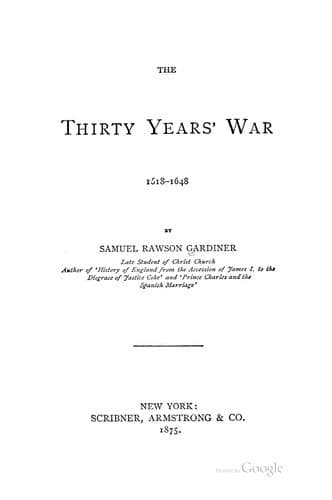
The Thirty Years' War, 1618-1648Gardiner, Samuel Rawson
History
The Thirty Years' War, 1618-1648
Gardiner, Samuel Rawson
Thirty Years' War, 1618-1648
For purposes of offence, too, there was much to induce Gustavus to
prefer the westward march. Thither Tilly had retreated with only the
semblance of an army still in the field. There, too, were the long
string of ecclesiastical territories, the Priest's Lane, as men called
it, Würzburg, Bamberg, Fulda, Cologne, Treves, Mentz, Worms, Spires, the
richest district in Germany, which had furnished men and money to the
armies of the League, and which were now to furnish at least money to
Gustavus. There Spain, with its garrisons on the left bank of the Rhine,
was to be driven back, and France to be conciliated, whilst the
foundations were laid of a policy which would provide for order in
Protestant Germany, so as to enable Gustavus to fulfil in a new and
better spirit the work left undone by Christian of Anhalt. Was it
strange if the Swedish king thought that such work as this would be
better in his own hands than in those of John George of Saxony?
SECTION III.--_March of Gustavus into South Germany._
[Sidenote: § 1. March of Gustavus upon the Rhine.]
The march of the victorious army was a triumphal progress. On October 2,
Gustavus was at Erfurt. On the 10th he entered Würzburg: eight days
later, the castle on its height beyond the Main was stormed after a
fierce defence. Through all the north the priests were expelled from the
districts which had been assigned them by the Edict of Restitution.
Gustavus was bent upon carrying on reprisals upon them in their own
homes. On December 16, Oppenheim was stormed and its Spanish garrison
put to the sword. The Priest's Lane was defenceless. Gustavus kept his
Christmas at Mentz. His men, fresh from the rough fare and hard quarters
of the north, revelled in the luxuries of the southern land, and drank
deep draughts of Rhenish wine from their helmets.
[Sidenote: § 2. Gustavus at Mentz.]
There is always a difficulty in conjecturing the intentions of Gustavus.
He did not, like Ferdinand, form plans which were never to be changed.
He did not, like Wallenstein, form plans which he was ready to give up
at a moment's notice for others entirely different. The essence of his
policy was doubtless the formation, under his own leadership, of the
_Corpus Evangelicorum_. What was to be done with the ecclesiastical
territories which broke up the territorial continuity of South German
Protestantism he had, perhaps, not definitely decided. But everything
points to the conclusion that he wished to deal with them as Wallenstein
would have dealt with them, to parcel them out amongst his officers and
amongst the German princes who had followed his banner. In doing so, he
would have given every security to the Catholic population. Gustavus, at
least in Germany, meddled with no man's religion. In Sweden it was
otherwise. There, according to the popular saying, there was one king,
one religion, and one physician.
[Sidenote: § 3. The French startled at his victories.]
Public-domain text, read in full here on John Shaqi.
Reviews
Reviews
No reviews yet
Be the first to share your thoughts on this work.
Elsewhere in the archive
Join the Discussion
Join the discussion
Sign in to leave a comment or review.
Sign InorCreate an account