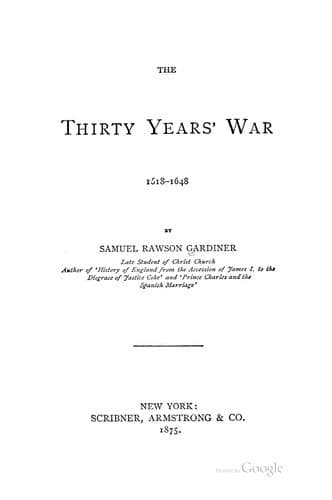
The Thirty Years' War, 1618-1648Gardiner, Samuel Rawson
History
The Thirty Years' War, 1618-1648
Gardiner, Samuel Rawson
Thirty Years' War, 1618-1648
[Sidenote: § 7. Gustavus at Augsburg and Munich.]
The conqueror pushed on. In Augsburg he found a city which had suffered
much from the Commissions of Resumption which had, in the south,
preceded the Edict of Restitution. The Lutheran clergy had been driven
from their pulpits; the Lutheran councillors had been expelled from the
town hall. In the midst of the jubilant throng Gustavus felt himself
more strongly seated in the saddle. Hitherto he had asked the
magistrates of the recovered cities to swear fidelity to him as long as
the war lasted. At Augsburg he demanded the oath of obedience as from
subjects to a sovereign. Gustavus was beginning to fancy that he could
do without France.
Then came the turn of Bavaria. As Gustavus rode into Munich, Frederick,
the exiled Elector Palatine, was by his side, triumphing over the flight
of his old enemy. It was not the fault of Gustavus if Frederick was not
again ruling at Heidelberg. Gustavus had offered him his ancestral
territories on the condition that he would allow Swedish garrisons to
occupy his fortresses during the war, and would give equal liberty to
the Lutheran and the Calvinist forms of worship. Against this latter
demand Frederick's narrow-hearted Calvinism steeled itself, and when,
not many months later, he was carried off by a fever at Bacharach, he
was still, through his own fault, a homeless wanderer on the face of the
earth.
[Sidenote: § 8. Gustavus at Munich.]
At Munich Gustavus demanded a high contribution. Discovering that
Maximilian had buried a large number of guns in the arsenal, he had them
dug up again by the Bavarian peasants, who were glad enough to earn the
money with which the foreign invader paid them for their labours. When
this process was over--waking up the dead, he merrily called it--he
prepared to leave the city with his booty. During his stay he had kept
good discipline, and took especial care to prohibit any insult to the
religion of the inhabitants. If, as may well have been the case, he was
looking beyond the _Corpus Evangelicorum_ to the Empire itself, if he
thought it possible that the golden crown of Ferdinand might rest next
upon a Lutheran head, he was resolved that religious liberty, not narrow
orthodoxy, should be the corner-stone on which that Empire should be
built.
[Sidenote: § 9. Strong position of Gustavus.]
All Germany, except the hereditary dominions of the House of Austria,
was at his feet. And he knew well that, as far as those dominions were
concerned, there was no strength to resist him. Ferdinand had done
enough to repress the manifestation of feeling, nothing to organize it.
He would have been even more helpless to resist a serious attack than he
had been in 1619, and this time Bavaria was as helpless as himself. Even
John George, who had fled hastily from the field of Breitenfeld, marched
through Bohemia without finding the slightest resistance. His army
entered Prague amidst almost universal enthusiasm.
Public-domain text, read in full here on John Shaqi.
Reviews
Reviews
No reviews yet
Be the first to share your thoughts on this work.
Elsewhere in the archive
Join the Discussion
Join the discussion
Sign in to leave a comment or review.
Sign InorCreate an account