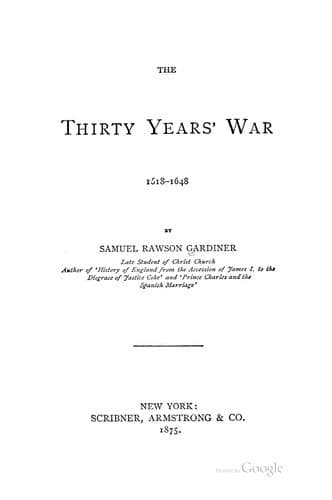
The Thirty Years' War, 1618-1648Gardiner, Samuel Rawson
History
The Thirty Years' War, 1618-1648
Gardiner, Samuel Rawson
Thirty Years' War, 1618-1648
All this, however welcome to France, boded no good to Germany. In the
old struggles of the sixteenth century, Catholic and Protestant each
believed himself to be doing the best, not merely for his own country,
but for the world in general. Alva, with his countless executions in the
Netherlands, honestly believed that the Netherlands as well as Spain
would be the better for the rude surgery. The English volunteers, who
charged home on a hundred battle-fields in Europe, believed that they
were benefiting Europe, not England alone. It was time that all this
should cease, and that the long religious strife should have its end. It
was well that Richelieu should stand forth to teach the world that there
were objects for a Catholic state to pursue better than slaughtering
Protestants. But the world was a long way, in the seventeenth century,
from the knowledge that the good of one nation is the good of all, and
in putting off its religious partisanship France became terribly hard
and selfish in its foreign policy. Gustavus had been half a German, and
had sympathized deeply with Protestant Germany. Richelieu had no
sympathy with Protestantism, no sympathy with German nationality. He
doubtless had a general belief that the predominance of the House of
Austria was a common evil for all, but he cared chiefly to see Germany
too weak to support Spain. He accepted the alliance of the League of
Heilbronn, but he would have been equally ready to accept the alliance
of the Elector of Bavaria if it would have served him as well in his
purpose of dividing Germany.
[Sidenote: § 7. His policy French, not European.]
The plan of Gustavus might seem unsatisfactory to a patriotic German,
but it was undoubtedly conceived with the intention of benefiting
Germany. Richelieu had no thought of constituting any new organization
in Germany. He was already aiming at the left bank of the Rhine. The
Elector of Treves, fearing Gustavus, and doubtful of the power of Spain
to protect him, had called in the French, and had established them in
his new fortress of Ehrenbreitstein, which looked down from its height
upon the low-lying buildings of Coblentz, and guarded the junction of
the Rhine and the Moselle. The Duke of Lorraine had joined Spain, and
had intrigued with Gaston. In the summer of 1632 he had been compelled
by a French army to make his submission. The next year he moved again,
and the French again interfered, and wrested from him his capital of
Nancy. Richelieu treated the old German frontier-land as having no
rights against the King of France.
SECTION II.--_Wallenstein's Attempt to dictate Peace._
[Sidenote: § 1. Saxon negotiations with Wallenstein.]
Public-domain text, read in full here on John Shaqi.
Reviews
Reviews
No reviews yet
Be the first to share your thoughts on this work.
Elsewhere in the archive
Join the Discussion
Join the discussion
Sign in to leave a comment or review.
Sign InorCreate an account