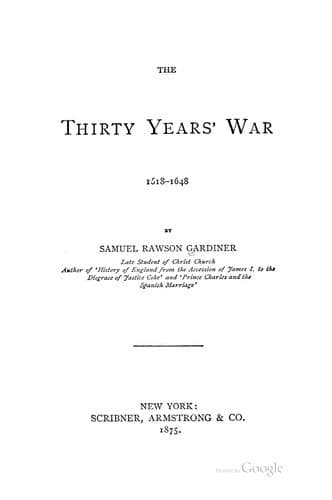
The Thirty Years' War, 1618-1648Gardiner, Samuel Rawson
History
The Thirty Years' War, 1618-1648
Gardiner, Samuel Rawson
Thirty Years' War, 1618-1648
On the 3d of August, 1645, a second battle of Nördlingen was fought. It
was almost a repetition of the slaughter of Freiburg. As in the year
before, Turenne had been left to do the hard work at the opening of the
campaign with inferior forces, and had even suffered a check. Once more
Enghien came up, gay and dashing, at the head of a reinforcement of
picked men. Once more a fearful butchery ensued. But that Mercy was
slain early in the fight, the day might have gone hard with the French.
As it was, they were able to claim a victory. The old German bands which
had served under Bernhard held out to the uttermost and compelled the
enemy to retreat. But the success was not lasting. The imperialists
received reinforcements, and the French were driven back upon the
Rhine.
[Sidenote: § 9. Battle of Jankow.]
The same year had opened with splendid expectations on the other side of
the theatre of the war. The gouty Swedish general, Torstenson, who had
taken up Baner's work in the north, burst suddenly into Bohemia, and on
the 6th of March inflicted a crushing defeat on the imperialists at
Jankow. He then harried Moravia, and pressed on to lay siege to Vienna,
as if to repair the fault which it was the fashion to ascribe to
Gustavus. But Vienna was unassailable, and Torstenson, like Turenne, was
driven to retreat. He next tried to reduce Brünn. Failing in this he
returned to Bohemia, where, worn out with his maladies, he delivered
over the command to Wrangel, his appointed successor.
CHAPTER XI.
THE END OF THE WAR.
SECTION I.--_Turenne's Strategy._
[Sidenote: 1643.
§ 1. Thoughts of peace.]
At last the thought entered into men's minds that it was time to put a
stop to this purposeless misery and slaughter. It was hopeless to think
any longer of shaking the strong grasp of France upon the Rhine; and if
Sweden had been foiled in striking to the heart of the Austrian
monarchy, she could not be driven from the desolate wilderness which
now, by the evil work of men's hands, stretched from the Baltic far away
into the interior of Germany. Long ago the disciplined force which
Gustavus had brought across the sea had melted away, and a Swedish army
was now like other armies--a mere collection of mercenaries, without
religion, without pity, and without remorse.
[Sidenote: § 2. Meeting of diplomatists.]
Public-domain text, read in full here on John Shaqi.
Reviews
Reviews
No reviews yet
Be the first to share your thoughts on this work.
Elsewhere in the archive
Join the Discussion
Join the discussion
Sign in to leave a comment or review.
Sign InorCreate an account