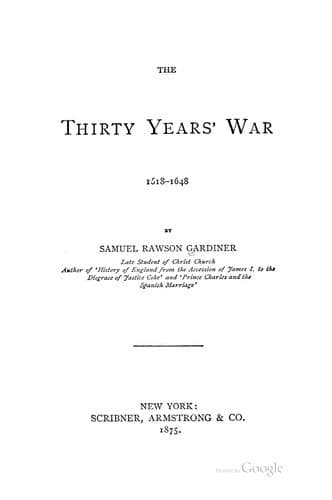
The Thirty Years' War, 1618-1648Gardiner, Samuel Rawson
History
The Thirty Years' War, 1618-1648
Gardiner, Samuel Rawson
Thirty Years' War, 1618-1648
With grim purpose Turenne and Wrangel set themselves to
make desolate the Bavarian plain, so that it might be rendered incapable
of supporting a Bavarian army. Maximilian was reduced to straits such as
he had not known since the time when Tilly fell at the passage of the
Lech. Sorely against his will he signed, in May, 1647, a separate truce
with the enemy.
[Sidenote: § 8. Last struggles of the war.]
The truce did not last long. In September Maximilian was once more on
the Emperor's side. Bavaria paid dearly for the elector's defection. All
that had been spared a year before fell a sacrifice to new devastation.
The last great battle of the war was fought at Zusmarshausen on May 17,
1648. The Bavarians were defeated and the work of the destroyer went on
yet for a while unchecked. In Bohemia half of Prague fell into the hands
of the Swedes, and the Emperor was left unaided to bear up in the
unequal fight.
SECTION II.--_The Treaty of Westphalia._
[Sidenote: § 1. The Peace of Westphalia.]
Ferdinand could resist no longer. On the 24th of October, 1648, a few
months before Charles I. ascended the scaffold at Whitehall, the Peace
of Westphalia was signed.
[Sidenote: § 2. Religious settlement.]
The religious difficulty in Germany was settled as it ought to have been
settled long before. Calvinism was to be placed on the same footing as
Lutheranism. New-Year's day 1624 was fixed upon as the date by which all
disputes were to be tested. Whatever ecclesiastical benefice was in
Catholic hands at that date was to remain in Catholic hands forever.
Ecclesiastical benefices in Protestant hands at that date were to remain
in Protestant keeping. Catholics would never again be able to lay claim
to the bishoprics of the north. Even Halberstadt, which had been
retained at the Peace of Prague, was now lost to them. To make this
settlement permanent, the Imperial Court was reconstituted. Protestants
and Catholics were to be members of the court in equal numbers. And if
the judicial body was such as to make it certain that its sanction would
never be given to an infringement of the peace, the Catholic majority in
the Diet became powerless for evil.
[Sidenote: § 3. Political settlement.]
Public-domain text, read in full here on John Shaqi.
Reviews
Reviews
No reviews yet
Be the first to share your thoughts on this work.
Elsewhere in the archive
Join the Discussion
Join the discussion
Sign in to leave a comment or review.
Sign InorCreate an account