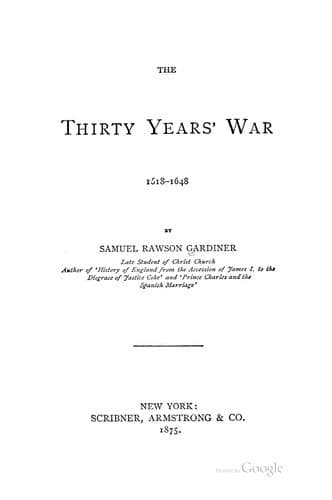
The Thirty Years' War, 1618-1648Gardiner, Samuel Rawson
History
The Thirty Years' War, 1618-1648
Gardiner, Samuel Rawson
Thirty Years' War, 1618-1648
The losses of the civil population were almost incredible. In a certain
district of Thuringia which was probably better off than the greater
part of Germany, there were, before the war cloud burst, 1,717 houses
standing in nineteen villages. In 1649, only 627 houses were left. And
even of the houses which remained many were untenanted. The 1,717 houses
had been inhabited by 1,773 families. Only 316 families could be found
to occupy the 627 houses. Property fared still worse. In the same
district 244 oxen alone remained of 1,402. Of 4,616 sheep, not one was
left. Two centuries later the losses thus suffered were scarcely
recovered.
[Sidenote: § 3. Moral decadence.]
And, as is always the case, the physical decline of the population was
accompanied by moral decadence. Men who had been accustomed to live by
the strong arm, and men who had been accustomed to suffer all things
from those who were strong, met one another, even in the days of peace,
without that mutual respect which forms the basis of well-ordered life.
Courts were crowded with feather-brained soldiers whose highest ambition
was to bedeck themselves in a splendid uniform and to copy the latest
fashion or folly which was in vogue at Paris or Versailles. In the
country district a narrow-minded gentry, without knowledge or culture,
domineered over all around, and strove to exact the uttermost farthing
from the peasant in order to keep up the outward appearance of rank. The
peasant whose father had been bullied by marauding soldiers dared not
lift up his head against the exactions of the squire. The burden of the
general impoverishment fell heavily upon his shoulders. The very pattern
of the chairs on which he sat, of the vessels out of which he ate and
drank, assumed a ruder appearance than they had borne before the war. In
all ranks life was meaner, poorer, harder than it had been at the
beginning of the century.
[Sidenote: § 4. Intellectual decline even before the war.]
If much of all this was the result of the war, something was owing to
causes antecedently at work. The German people in the beginning of the
seventeenth century was plainly inferior to the German people in the
beginning of the sixteenth century. During the whole course of the war
Maximilian of Bavaria was the only man of German birth who rose to
eminence, and even he did not attain the first rank. The destinies of
the land of Luther and Göthe, of Frederick II. and Stein were decided by
a few men of foreign birth. Wallenstein was a Slavonian, Tilly a
Walloon, Gustavus a Swede, Richelieu a Frenchman. The penalty borne by a
race which was unable to control individual vigour within the limits of
a large and fruitful national life was that individual vigour itself
died out.
[Sidenote: § 5. Difficulties inherited from early times.]
Public-domain text, read in full here on John Shaqi.
Reviews
Reviews
No reviews yet
Be the first to share your thoughts on this work.
Elsewhere in the archive
Join the Discussion
Join the discussion
Sign in to leave a comment or review.
Sign InorCreate an account