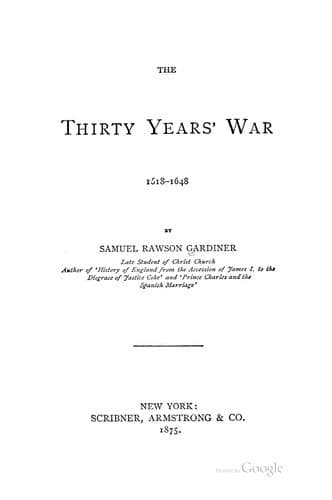
The Thirty Years' War, 1618-1648Gardiner, Samuel Rawson
History
The Thirty Years' War, 1618-1648
Gardiner, Samuel Rawson
Thirty Years' War, 1618-1648
Suddenly, when Mazarin's government appeared most firmly rooted, there
was an explosion which threatened to change the whole face of France. An
outcry arose for placing restrictions upon rights of the crown, for
establishing constitutional and individual liberties. The Fronde, as the
party which uttered the cry was called, did its best to imitate the
English Long Parliament whose deeds were then ringing through the world.
But there were no elements in France upon which to establish
constitutional government. The Parliament of Paris, which wished itself
to be considered the chief organ of that government, was a close
corporation of lawyers, who had bought or inherited judicial places; and
of all governments, a government in the hands of a close corporation of
lawyers is likely, in the long run, to be the most narrow-minded and
unprogressive of all possible combinations; for it is the business of a
lawyer to administer the law as it exists, not to modify it in
accordance with the new facts which rise constantly to the surface of
social and political life. Nor were the lawyers of the parliament
fortunate in their supporters. The Paris mob, combined with a knot of
intriguing courtiers, could form no firm basis for a healthy
revolution. It was still worse when Condé, quarrelling on a personal
question with Mazarin, raised the standard of aristocratic revolt, and
threw himself into the arms of the Spanish invader. Mazarin and the
young king represented the nation against aristocratic selfishness and
intrigue; and when they obtained the services of Turenne, the issue was
hardly doubtful. In 1652 Lewis XIV. entered Paris in triumph. In 1653
Condé, in conjunction with a Spanish army, invaded France, and pushed on
hopefully for Paris. But Turenne was there with a handful of troops; and
if Condé was the successor of Gustavus in the art of fighting battles,
Turenne was Wallenstein's successor in the art of strategy. Condé could
neither fight nor advance with effect. The siege and reduction of Rocroy
was the only result of a campaign which had been commenced in the
expectation of reducing France to submission.
[Sidenote: § 4. The war with Spain.]
In 1654 Condé and the Spaniards laid siege to Arras, whilst the French
were besieging Stenay. Stenay was taken; Arras was relieved. In 1655
further progress was made by the French on the frontier of the
Netherlands; but in 1656 they failed in the siege of Valenciennes.
[Sidenote: § 5. France, Cromwell, and Spain.]
Public-domain text, read in full here on John Shaqi.
Reviews
Reviews
No reviews yet
Be the first to share your thoughts on this work.
Elsewhere in the archive
Join the Discussion
Join the discussion
Sign in to leave a comment or review.
Sign InorCreate an account