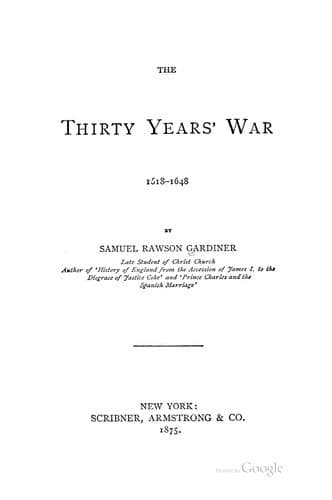
The Thirty Years' War, 1618-1648Gardiner, Samuel Rawson
History
The Thirty Years' War, 1618-1648
Gardiner, Samuel Rawson
Thirty Years' War, 1618-1648
After all, however, the main point was the success or failure of the
king to gain support in Germany itself. The circle of Lower Saxony,
indeed, chose him for its military chief. But even then there was much
division of opinion. With the commercial classes in the towns war
against the Emperor was as yet decidedly unpopular. They were tolerably
well assured that they would reap no benefit from any accession of
strength to the princes, whilst the danger from the Emperor was still in
the future. But they were not strong enough to carry the circle with
them. A centre of resistance was formed, which must be broken down if
the Emperor's pretensions were not to be abated. On July 18 Tilly
crossed the Weser into Lower Saxony, and the Danish war began.
SECTION III.--_Wallenstein's Armament._
[Sidenote: § 1. The Emperor's need of support.]
Would Tilly's force be sufficient to overcome the King of Denmark and
his foreign allies? Ferdinand and his ministers doubted it. In
proportion as his power increased, the basis on which it rested grew
narrower. Of his allies of 1620 the League alone supported him still.
Spain, exhausted for the time with the siege of Breda, could do little
for him, and contented herself with forming clever plans for cajoling
the Elector of Saxony, and with urging the Pope to flatter the Lutherans
by declaring them to be far better than the Calvinists. Of all such
schemes as this nothing satisfactory was likely to come. John George of
Saxony, indeed, refused to join in the King of Denmark's movement. He
thought that the Lower Saxony princes ought to have been content with
the agreement of Mühlhausen, and that Frederick ought to have made his
submission to the Emperor. But even in the eyes of John George the Lower
Saxon war was very different from the Bohemian war. The Emperor's
refusal to confirm permanently the Protestant bishoprics had made it
impossible for any Protestant to give him more than a passive support.
[Sidenote: § 2. His numerous enemies.]
And if the Emperor's friends were fewer, his enemies were more numerous.
Christian IV. was more formidable than Frederick. Bethlen Gabor, who had
made peace in 1622, was again threatening in the east; and no one could
say how soon France might be drawn into the strife in the west.
Ferdinand needed another army besides Tilly's. Yet his treasury was so
empty that he could not afford to pay a single additional regiment.
[Sidenote: § 3. Wallenstein's offer.]
Public-domain text, read in full here on John Shaqi.
Reviews
Reviews
No reviews yet
Be the first to share your thoughts on this work.
Join the Discussion
Join the discussion
Sign in to leave a comment or review.
Sign InorCreate an account