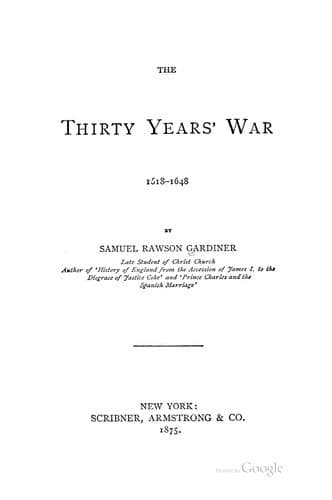
The Thirty Years' War, 1618-1648Gardiner, Samuel Rawson
History
The Thirty Years' War, 1618-1648
Gardiner, Samuel Rawson
Thirty Years' War, 1618-1648
Suddenly, in the midst of his difficulties, one of his own subjects
offered to take the burden on his shoulders. Albert of Waldstein,
commonly known as Wallenstein, sprang from an impoverished branch of one
of the greatest of the families of the Bohemian aristocracy. His parents
were Lutheran, but when, at the age of twelve, he was left an orphan, he
was placed under the care of an uncle, who attempted to educate him in
the strict school of the Bohemian Brotherhood, a body better known in
later times under the name of Moravians, and distinguished, as they are
now, for their severe moral training.
[Sidenote: § 4. His early life.]
The discipline of the brethren seems to have had much the same
influence upon the young nobleman that the long sermons of the Scotch
Presbyterians had upon Charles II. The boy found his way to the Jesuits
at Olmütz, and adopted their religion, so far as he adopted any
religion at all. His real faith was in himself and in the revelations of
astrology, that mystic science which told him how the bright rulers of
the sky had marked him out for fame. For a young Protestant of ability
without wealth there was no room in Bohemia under the shadow of the
great houses. With Ferdinand, as yet ruler only of his three hereditary
duchies, he found a soldier's welcome, and was not long in displaying a
soldier's capacity for war. To Wallenstein no path came amiss which led
to fortune. A wealthy marriage made him the owner of large estates. When
the revolution broke out he was colonel of one of the regiments in the
service of the Estates of Moravia. The population and the soldiers were
alike hostile to the Emperor. Seizing the cash-box of the estates he
rode off, in spite of all opposition, to Vienna. Ferdinand refused to
accept booty acquired after the fashion of a highwayman, and sent the
money back to be used against himself. The Moravians said openly that
Wallenstein was no gentleman. But the events which were hurrying on
brought his name into prominence in connexion with more legitimate
warfare, and he had become famous for many a deed of skill and daring
before Frederick's banner sunk before the victors on the White Hill.
[Sidenote: § 5. Offers to raise an army.]
Public-domain text, read in full here on John Shaqi.
Reviews
Reviews
No reviews yet
Be the first to share your thoughts on this work.
Join the Discussion
Join the discussion
Sign in to leave a comment or review.
Sign InorCreate an account