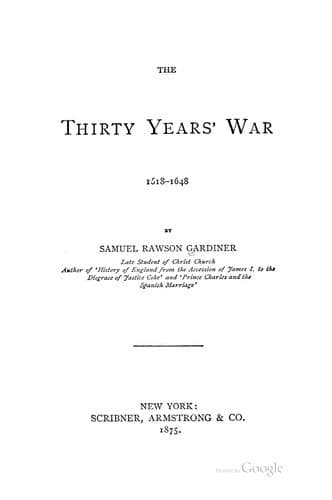
The Thirty Years' War, 1618-1648Gardiner, Samuel Rawson
History
The Thirty Years' War, 1618-1648
Gardiner, Samuel Rawson
Thirty Years' War, 1618-1648
The dislike of the rule of the sword which was felt amongst those for
whom that sword had been drawn was sure to be felt far more strongly in
the Protestant cities of North Germany. Up to Wallenstein's appearance
the commercial oligarchies by which those cities were governed, had
shown themselves at the best but lukewarm in the Protestant cause. The
towns of the south had been the first to desert the Union. The towns of
the north had been dragged half against their will into the Danish war.
To them the imperial sway was connected by a tradition of centuries with
support against the encroachments of the princes. But they had no
traditions in favour of an army living at free quarters amongst them, of
bullying colonels and hectoring soldiers. Magdeburg braved all the
terrors of Wallenstein's anger rather than admit a single company within
its walls. Hamburg declared itself ready to submit to the Emperor's
authority, but closed its gates against his army. And though Magdeburg
might be besieged when there was leisure, Hamburg and the other maritime
towns were less easily to be gained. All-powerful on land, Wallenstein's
authority ended at low-water mark. The King of Denmark had fled to his
islands. The King of Sweden was master of the Baltic. If it was doubtful
whether they could set an army in battle array in Germany, at least they
could throw provisions and munitions of war into a besieged seaport
town. If the Empire was to be secured, these seaports must be brought
under the Emperor's authority.
[Sidenote: § 5. Wallenstein in possession of the Duchy of Mecklenburg.]
Here, therefore, in the midst of the danger Wallenstein determined to
plant himself firmly, with the instinctive conviction that the post of
danger is the post of power. The two Dukes of Mecklenburg had steadily
supported the King of Denmark in his struggle against the Emperor. In
1627, when most of the other states ceased to pay any contributions
towards the war, they had continued to fulfil their engagements, and
though they now professed their readiness to make their submission, it
was Wallenstein's interest to make the most of their treason, and the
least of their repentance. In February, 1628, the Emperor, using the
rights which he had claimed in the case of the Elector Palatine,
declared them to have forfeited their lands and dignities, and placed
the Duchies in Wallenstein's hands as a pledge for the payment of
military expenses which still remained to be liquidated. It was
significant of the change of feeling in Germany that the ecclesiastical
electors, who had seen nothing amiss in the deprivation of Frederick,
had not a good word to say for this concession to Wallenstein.
[Sidenote: § 6. Negotiation with the Hanse Towns.]
Public-domain text, read in full here on John Shaqi.
Reviews
Reviews
No reviews yet
Be the first to share your thoughts on this work.
Elsewhere in the archive
Join the Discussion
Join the discussion
Sign in to leave a comment or review.
Sign InorCreate an account